The Fire That Does Not Burn: On Schutz
das Wort / the word: der Schutz (m.), no common plural
Aussprache / pronunciation: SHOOTS
Wortart / part of speech: Noun, masculine
Register: Everyday and technical both. Used for insurance policies, wildlife conservation, and Wotan's ring of fire alike.
Nicht Gefängnis, Sondern Grenze / Not a Prison, But a Boundary

Schutz is easy to mistranslate as simple safety, but the word implies something more active than that. Sicherheit is the state of being safe, a condition. Schutz is the act or structure that produces that condition, a boundary maintained against a threat. A Schutzwall is a protective wall. Schutzimpfung is a protective vaccination. In every case, Schutz names not the absence of danger but the deliberate work of holding danger at bay. It is defensive, not passive.
This distinction matters enormously for the final scene of Die Walküre, because it is easy to see Wotan's ring of fire around the sleeping Brünnhilde as a punishment, a prison built from flame. But the German vocabulary Wagner is working within points somewhere else. Schutz is not confinement. A cage keeps something in. Schutz keeps something out. Wotan is not imprisoning his daughter. He is building the one thing he can still offer her after stripping away her godhood: a boundary between her and anyone unworthy of waking her.
Die Strafe, Die Eine Gabe Ist / The Punishment That Is a Gift

Wotan sentences Brünnhilde to mortality and sleep as punishment for her disobedience. But he cannot bring himself to leave her defenseless. The compromise he settles on, ringing her with fire so that only a hero without fear can pass through, is the clearest expression in the entire Ring of how Schutz differs from mere restriction. He is limiting who can reach her. He is not eliminating her agency inside that limit. The fire does not decide her fate. It only decides who is permitted to try.
This is a father disciplining a daughter while still, against his own explicit sentence, finding a way to protect her. The scene works because the two impulses, punishment and protection, are not presented as contradictory. They are fused into a single act. Wotan cannot undo what Brünnhilde did or the consequence that follows from it. What he can still control is the boundary around her vulnerability, and he uses every bit of power he has left to make that boundary as fierce as possible.
Feuer Als Grenze, Nicht Als Zerstörung / Fire as Boundary, Not as Destruction

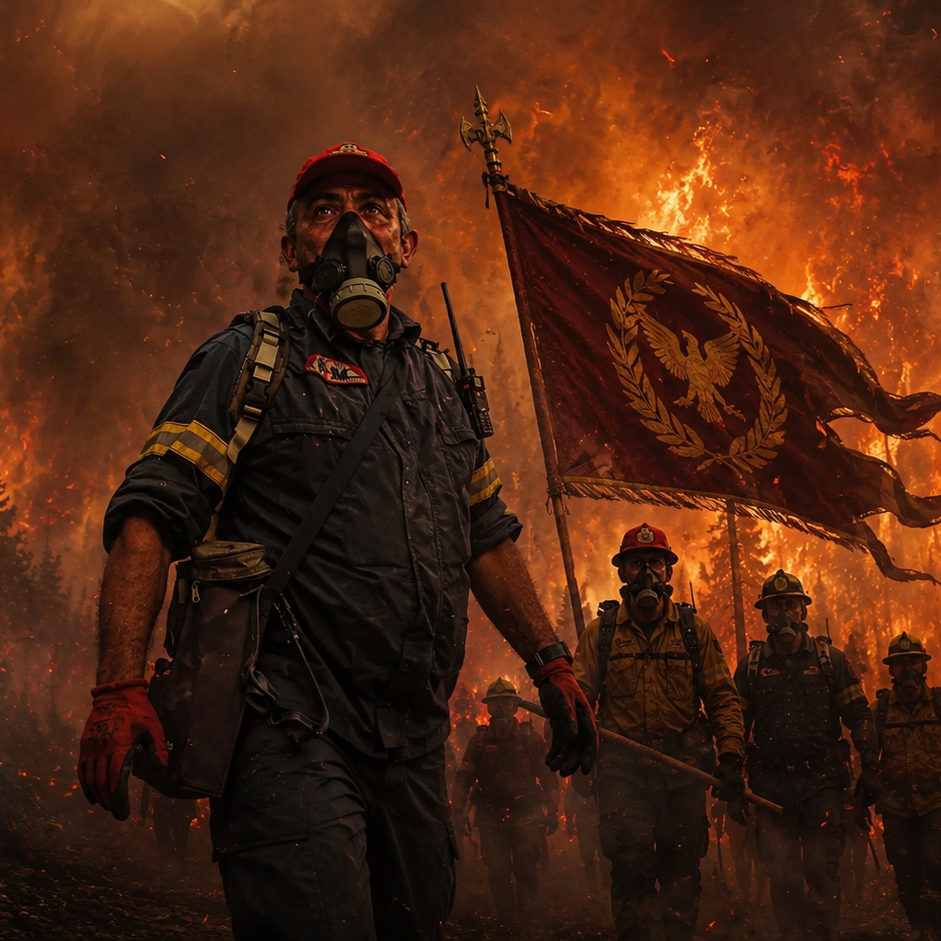
German distinguishes between Feuer, fire generally, and the specific compound Schutzfeuer, protective fire, used literally in firefighting for a controlled burn set to stop a larger blaze from spreading. This is exactly the logic of the Magic Fire Music. The flame does not consume. It contains. It is set deliberately, shaped deliberately, meant to hold a line rather than raze what stands behind it. Wagner's orchestration supports this reading directly: the Magic Fire theme shimmers and flickers rather than roars, suggesting something closer to a controlled boundary than an act of destruction.
This is worth holding against the ring of fire that runs through the earlier operas too. Alberich renounced love to seize gold that became a different kind of ring entirely, one built on possession and control. Wotan's ring of fire around Brünnhilde inverts that logic completely. It is not built to extract or possess anything. It exists only to keep something safe until the right person arrives to claim it honestly. Where the first ring corrupted everything it touched, this one waits, patient and fierce, for a hero it cannot compel and can only permit.
Grammatik / Grammar

Der Schutz is masculine, generally used without a plural in its abstract sense (a plural, die Schutze, is technically possible but rarely heard).
Key constructions:
Schutz bieten, to offer protection
unter jemandes Schutz stehen, to be under someone's protection
der Schutzwall, a protective wall or rampart
das Schutzfeuer, a protective or controlled fire (used literally in firefighting)
schützen (v.), to protect
der Beschützer, a protector (a person, rather than the abstract condition)
Note the difference between Schutz (the active work of protecting) and Sicherheit (the resulting state of safety). Wotan provides the former. Whether Brünnhilde ever again feels the latter is a question the opera leaves open.
Verwandte Wörter / Related Words

die Sicherheit (f.), safety, security (the resulting state, distinct from the active work of Schutz)
schützen (v.), to protect
der Beschützer (m.), protector
die Grenze (f.), boundary, border
das Feuer (n.), fire
die Strafe (f.), punishment
bewahren (v.), to preserve, to keep safe
der Trotz (m.), defiance (last essay's word: the act Brünnhilde is being both punished and protected for)
Die Verbindung zum Weg / Connection to the Walk

The walk ends at Riverbank State Park, facing west toward the Hudson and the Palisades, timed for golden hour. Start the Magic Fire Music as the sun begins its descent. Let each orchestral surge track the deepening orange of the sky. This is deliberate staging, not coincidence: the real sunset becomes the fire Wotan lights around his daughter, and the walk's final gesture asks you to watch something both end and hold at the same time.
Wotan is not destroying Brünnhilde here. He is transforming the terms of her existence while refusing to leave her exposed inside that transformation. Watch the sun vanish completely behind the Palisades. The fire in the music does not stop when the light does. It keeps burning, low and steady, around whoever eventually proves worthy of crossing it.