The Ritual That Only Looks Like the Real Thing: On Schein
das Wort / the word: der Schein (m.), no plural in this sense
Aussprache / pronunciation: SHINE
Wortart / part of speech: Noun, masculine
Register: Everyday and philosophical both. Used for literal light and shine, and, in the philosophical register, for appearance set against underlying reality.
Nicht Sein, Sondern Schein / Not Being, But Seeming

German philosophy has long organized itself around the pairing of Sein, being, what is actually the case, and Schein, appearance, what merely seems to be the case. The distinction runs from Kant through Hegel and beyond, and it survives in ordinary speech too, in the idiom der Schein trügt, appearances deceive, a warning that what glitters and what is genuine are not reliably the same thing. Schein is not necessarily a lie. It can simply be surface, unconnected to whatever depth, if any, sits beneath it.
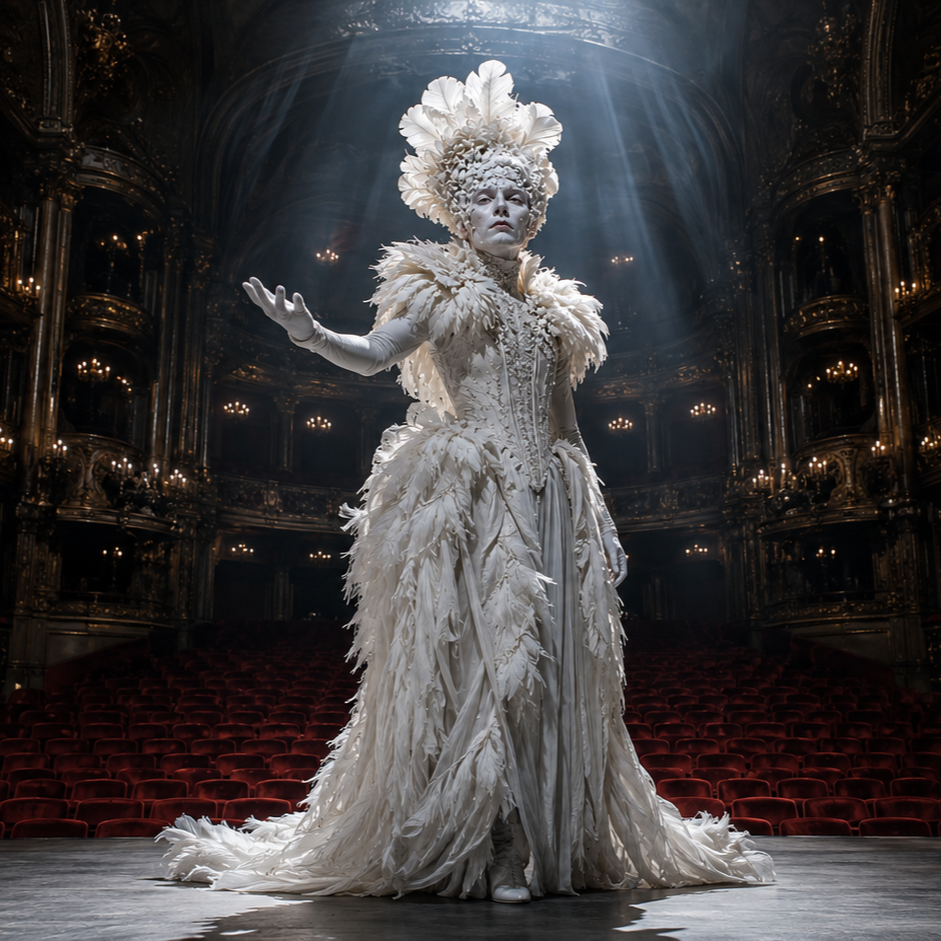
This is exactly the register the Gibichung court occupies once Siegfried arrives among Hagen's schemes. Nothing about Gunther's hall is technically false in the sense of being fabricated from nothing. The hospitality is real hospitality, the ceremony is real ceremony, the oaths sworn are actually spoken aloud. What has gone missing is the connection between the Schein of these forms and any Sein underneath them. The rituals continue exactly as rituals should. They have simply stopped meaning what they used to mean.
Charisma Als Macht Ohne Substanz / Charisma as Power Without Substance

Hagen does not rule the Gibichung court through force in any direct sense, the way Wotan once ruled through law or Fafner through hoarded gold. He rules through Schein, through the careful maintenance of appearances that let a hollow arrangement function exactly like a legitimate one. This project's own frame for the month names the mechanism directly: false community is efficient precisely because performing belonging costs so much less than actually building it, and because most onlookers, cheering along with a ritual, rarely stop to check whether the Sein underneath still matches the Schein on display.
This is a different kind of power than anything examined in earlier months. June's der Vertrag was a real, binding agreement, however coercive its terms. July's das Gebot was a real command, backed by real consequence for disobedience. Hagen's power runs on neither. It runs entirely on the continued performance of legitimacy, requiring no actual authority underneath it, only enough spectacle that nobody feels compelled to ask what is actually holding the arrangement together.
Weihe Und Schein / Consecration and Its Counterfeit

August's essay on die Weihe described consecration as a genuine ritual act, one that permanently transfers something from ordinary use into sacred use, real because it changes what a thing or person actually is. The rituals staged at the Gibichung court in this month's opera borrow the outward shape of that same kind of ceremony, oaths, blood-brotherhood, formal hospitality, without any of Weihe's underlying transformation. Siegfried and Gunther swear blood-brotherhood in a scene that looks, from the outside, exactly like the consecrations examined two months ago. The difference is that nothing here actually changes what either man is. The form is borrowed. The substance is absent.
This is the precise danger Schein represents once it becomes deliberate rather than accidental. An honest surface with no depth beneath it is simply shallow, forgivable, ordinary. A surface deliberately constructed to imitate a depth that was never built is something else, closer to counterfeit currency than to simple appearance. Hagen understands this difference better than anyone else in the opera, which is exactly why his version of ritual proves so much harder to see through than an obvious lie would have been.
Der Schein, Der Sich Selbst Glaubt / The Appearance That Believes Itself

What makes this month's Schein especially dangerous is that the crowd participating in it is not necessarily lying to itself on purpose. Cheering a hollow ritual does not require conscious cynicism. Most participants likely experience the ceremony as genuinely moving, precisely because Schein, well constructed, produces real feeling even when nothing real underlies it. This is the mechanism this project's own thematic frame names when it describes systems that do not collapse dramatically but instead fray, the machinery of belief becoming visible only just before it finally breaks.
A crowd swept up in Schein is not necessarily performing insincerity. It may simply have lost the habit of checking whether the forms it participates in still connect to anything underneath. This is, in its own way, a communal version of Siegfried's individual forgetting from the previous essay. Where he lost one specific memory to a potion, an entire court can lose, gradually and without any single dramatic moment, its capacity to distinguish appearance from the reality it was originally meant to represent.
Grammatik / Grammar

Der Schein is masculine and has no plural in this philosophical or ceremonial sense. A separate plural form, die Scheine, exists for the unrelated everyday meaning of banknotes or certificates, and should not be confused with this word's abstract use.
Key constructions:
der Schein trügt, appearances deceive
zum Schein, for appearance's sake, as a pretense
scheinbar (adv./adj.), apparently, seemingly (often implying the appearance is misleading)
Sein und Schein, being and appearance (the classical philosophical pairing)
scheinen (v.), to shine, or to seem, appear (context distinguishes the two senses)
Note that scheinen carries both the literal meaning, to shine, and the figurative one, to seem or appear, a genuinely useful ambiguity: light and illusion share the same verb in German, a coincidence worth pointing out to learners as a memory aid rather than a source of confusion.
Verwandte Wörter / Related Words

das Sein (n.), being, existence (the philosophical counterpart this word is defined against)
scheinbar (adj./adv.), apparent, seeming
die Täuschung (f.), deception, illusion
das Ritual (n.), ritual
die Weihe (f.), consecration (last essay's word: the genuine version of what this month's ceremonies only imitate)
die Spektakel (n., often used in plural die Spektakel), spectacle
echt (adj.), genuine, real (the quality Schein imitates without possessing)
die Fassade (f.), facade
Die Verbindung zum Weg / Connection to the Walk

Walk Ludlow, Orchard, and Essex Streets on the Lower East Side as Hagen's Watch and Summons plays, letting the neighborhood's own nightlife noise bleed into the music rather than fighting against it. Notice the performative belonging on display here, groups posturing toward each other in doorways and on corners, charisma doing the work that substance would otherwise have to do. None of it is necessarily fake in the sense of being consciously staged. Most of it is probably felt, in the moment, as genuinely as anything.
This is exactly the ambiguity this month's word is built to hold. Somewhere on these streets, forms of belonging are being performed that may or may not connect to anything durable underneath them, and there is no reliable way, walking past at night with music in your ears, to tell the difference from outside. That uncertainty is not a flaw in the walk. It is the walk's entire point.