Libretto: Die Sieger, Reimagining Wagner’s Unwritten Opera
Vorbemerkung
Wagner sketched Die Sieger in 1856, in the same months he was reading Schopenhauer and the first European translations of the Buddhist sutras. He kept the subject near him for twenty-seven years. Parts of it moved into Tristan. The figure of the compassionate fool was absorbed by Parsifal. In February 1883, at his desk in the Palazzo Vendramin in Venice, he was writing an essay on the feminine in the human. The essay broke off mid-sentence. He died that afternoon.
What follows is not a discovery. It is one possible completion. The 1856 prose sketch has been followed where it speaks and departed from where it does not. The mother, who in the sketch is a figure of rage, has been given a longer breath. The Buddha's teaching, which in the sketch hinges on karmic punishment, has been loosened toward compassion without mechanism. The compression is drawn from Parsifal and from the late essays. The ending is his own tendency, carried one step further: the cadence withheld.
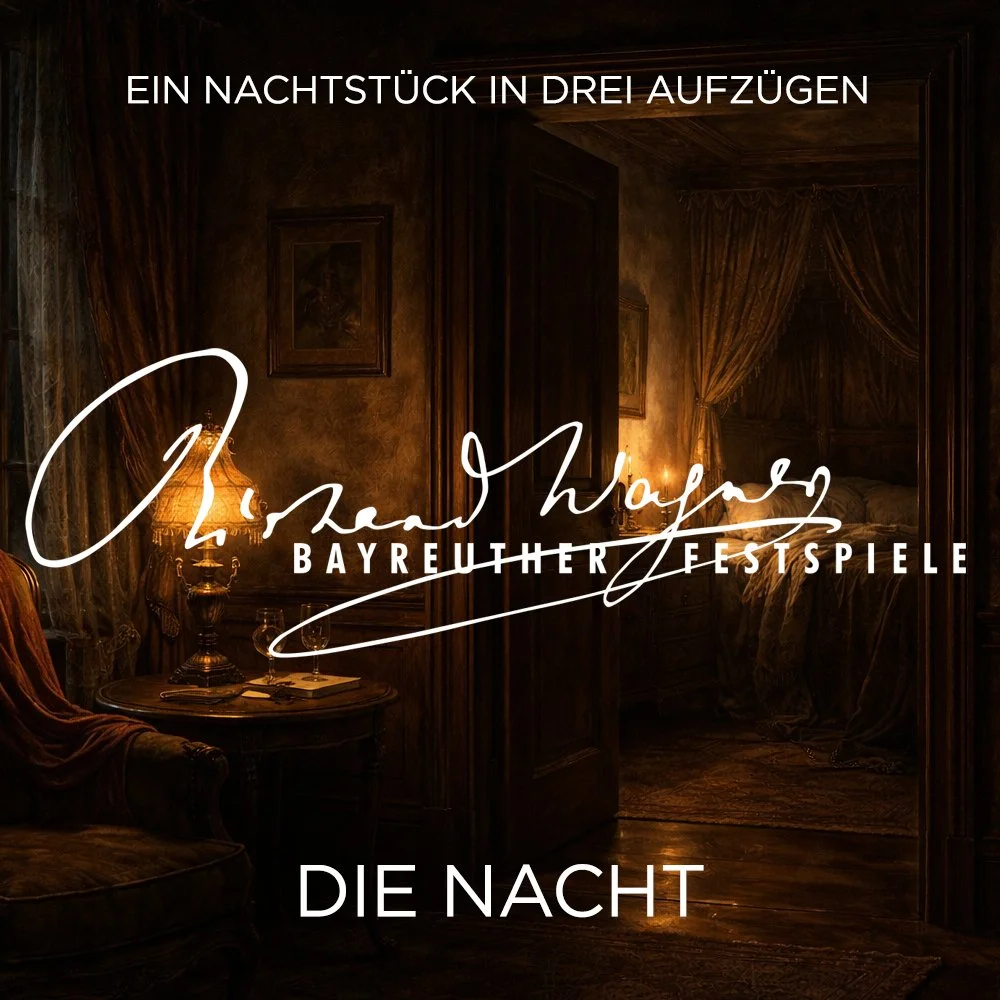
Die Sieger stands beside a speculative catalogue of works that were never sketched at all — Die Nacht, Sâvitrî, Das Ende der Musik — and it differs from them in kind: it is the one panel grounded in a document. With Sâvitrî it forms the Indian diptych, the two operas of Wagner's Schopenhauer years that he read toward and never wrote. A note on punctuation, carried over from the first version of this completion: questions in this work end with periods. In the world of the law, questions are not really open.
Personen
PRAKRITI, a young woman of the Chandala caste (soprano)
DIE MUTTER, her mother (contralto)
ANANDA, a monk, disciple of the Buddha (tenor)
DER BUDDHA (bass)
Disciples (silent chorus)
Vom Orchester
Der Brunnenton — the well-tone: a single low note, held; a second voice a whole tone above; a third. The sound that opens the work, and it does not resolve. It is the drone of the standing order — caste, law, river, sea.
Der Faden — the thread: the Mother's texture, played on an instrument from before the rest of the opera. It binds in the third scene. At the end of the work it is what the orchestra is unwoven from.
Das Rad — the wheel: a slow turning figure that enters with the Buddha. It has no opening accent and no closing accent; the listener can never say where one revolution ends and the next begins. The wheel does not punish. The wheel turns.
Das Ausfädeln — the unthreading: the closing procedure. The orchestra thins, thread by thread, until one instrument is playing; then that instrument is playing one note; then that note does not stop, but the theater understands that it has ended.
Erster und einziger Aufzug
Erste Szene
The orchestra opens on a single low note, held — der Brunnenton. A second voice enters a whole tone above. A third. The sound hangs, unresolved. The curtain rises on a stone well at the forest's edge. Dusk. PRAKRITI is drawing water. Her movements are careful. Her face is turned from the road.
aus der Erde kommst du auf.
Aus dem Schweigen, aus dem Schatten,
aus der Nacht, die nichts erinnert.
you rise from the earth.
From the silence, from the shadow,
from the night that remembers nothing.
ANANDA enters from the forest path, travel-worn, his robe the color of stone after rain. He carries an empty wooden bowl.
Mein Schatten fiele auf deinen.
Die Straße läuft an diesem Brunnen vorbei.
Die Hohen gehen vorüber. Die Niedern warten danach.
Nimm von einer andern.
My shadow would fall on yours.
The road runs past this well.
The high pass by. The low wait after.
Take from another.
Das Wasser hat kein Gedächtnis.
Ich bitte dich noch einmal. Mich dürstet.
The water has no memory.
I ask you again. I am thirsty.
Meine Großmutter war Tschandala.
Zurück bis zur ersten Frau, die den Fluss überschritt,
fiel unser Schatten dorthin, wohin deiner nicht fallen darf.
Nimm von einer andern. Ich flehe dich an.
My grandmother was Chandala.
Back to the first woman who crossed the river,
our shadow has fallen where yours should not fall.
Take from another. I beg you.
Das Dorf wies mich ab. Ich sprach fremd zu ihrem Priester.
Der Fluss war seicht. Ich nahm kein Wasser.
Schwester, gib mir zu trinken.
The village refused me. I spoke strangely to their priest.
The river was low. I took no water.
Sister, give me to drink.
A long pause. The orchestra thins to a single wavering line.
She pours. Their hands do not touch. When the bowl is full, she steps back as if from fire.
Stoff. Natur. Das, was sich entfaltet.
Matter. Nature. What unfolds.
Ich habe ihn nicht gewählt.
I did not choose it.
Ich bin Ananda. Ich gehe mit einem Lehrer.
Friede, Schwester. Friede deinem Haus.
I am Ananda. I walk with a teacher.
Peace, sister. Peace to your house.
He bows, turns, and goes. PRAKRITI stands at the well with the empty bowl she did not give. Her hand is still lifted where his had been.
Zweite Szene
Night falls in the orchestra. PRAKRITI alone. She does not move for a long time.
Er hat das Wasser genommen und ist gegangen.
Das Wasser gehörte nicht mir.
Es gehörte dem Brunnen.
Und ich gehöre der Kaste,
und die Kaste dem Gesetz,
und das Gesetz dem Fluss,
und der Fluss dem Meer,
und ich bin ein Tropfen, ein Tropfen, ein Tropfen.
He has taken the water and gone.
The water did not belong to me.
It belonged to the well.
And I belong to the caste,
and the caste to the law,
and the law to the river,
and the river to the sea,
and I am one drop, one drop, one drop.
Ein Licht, wo kein Fenster geschnitten ist.
Ein Klang, wo keine Glocke hängt.
A light where no window was cut.
A sound where no bell is hung.
Ananda. Es heißt Freude.
Es heißt die Freude, die nicht endet.
Ananda. It means joy.
It means the joy that does not end.
Ich trage das Wasser heim.
Ich stelle die Schale an den Herd.
Ich werde schlafen. Ich werde schlafen. Ich werde schlafen.
I will carry the water home.
I will set the bowl by the hearth.
I will sleep. I will sleep. I will sleep.
She lifts the water jug. It is heavier than before. She walks toward the hut, and the orchestra follows her not as accompaniment but as the weight she carries.
Dritte Szene
Interior of the hut. A low fire. The MOTHER, old and sinewed, sits on the floor. PRAKRITI enters, sets down the water, does not speak.
Er trank.
He drank.
Kein Priester, kein Krieger, kein Händler.
Nur die Niedern. Nur die Verstoßenen.
Nur die, die keinen andern haben.
Wer war er.
No priest, no warrior, no merchant.
Only the low. Only the cast off.
Only those who have no other.
Who was he.
Ein Mönch nahm Wasser von einer Tschandala.
Weißt du, was das bedeutet.
Weißt du, was das bedeutet.
Tochter. Weißt du, was das bedeutet.
A monk took water from a Chandala.
Do you know what this means.
Do you know what this means.
Daughter. Do you know what this means.
Ich weiß nicht, was geschehen ist.
Ich weiß nur: er muss wiederkommen.
Ich weiß nur: er muss.
I do not know what has happened.
I only know that he must come back.
I only know that he must.
Ich werde ihn wiederkommen machen.
Ich habe die alten Worte.
Meine Mutter lehrte mich, und ihre Mutter sie.
Sie haben uns nicht reich gemacht.
Sie haben unsern Schatten nicht gehoben.
Aber sie bringen einen Mann durch einen Wald,
der Wasser trinkt aus einer Tschandala-Hand.
I will make him come back.
I have the old words.
My mother taught me, and her mother her.
They did not make us rich.
They did not lift our shadow.
But they will bring a man across a forest
who drinks water from a Chandala hand.
She goes to a small carved box in the corner, wrapped in cloth. She opens it. The orchestra shifts: deeper, older, a texture that has not yet been heard — der Faden. An instrument from before the rest of the opera.
werde Faden, werde Schnur.
Schnur, zieh ihn, Faden, find ihn,
führ ihn wieder zu der Tür.
become thread, become cord.
Cord pull him, thread find him,
lead him back to the door.
Du sagtest ja am Brunnen.
Die Worte folgen nur.
You said yes at the well.
The words only follow.
Vierte Szene
The forest. ANANDA, walking alone, has turned back though he did not mean to. He stops. He cannot tell why. Under the thin light of the stars, a thread of the Mother's chant — der Faden — runs in the orchestra.
Der Weg war klar. Mein Schritt war sicher.
Und nun bin ich hier, wo ich nicht sein wollte.
Da ist ein Klang, den ich nicht hören kann.
Da ist eine Hand an meinem Ärmel, die nicht da ist.
The path was clear. My steps were sure.
And now I am here, where I did not mean to be.
There is a sound I cannot hear.
There is a hand on my sleeve that is not there.
He takes a step toward the hut. Stops.
Ich habe dem Hunger entsagt.
Ich glaubte, auch dem Durst entsagt zu haben.
Ich trank das Wasser. Ich dankte der Geberin.
Warum lässt die Geberin mich nicht los.
I vowed away from hunger.
I thought I had vowed away from thirst.
I drank the water. I thanked the giver.
Why does the giver not release me.
Another step.
Ihre Hand ist die Hand, die im Traum meine Schale füllt.
Ich habe das nicht gewählt. Ich habe das nicht gewählt.
Und doch gehe ich auf die Tür zu.
Her hand is the hand that serves my bowl in dreams.
I did not choose this. I did not choose this.
And yet I am walking toward the door.
He arrives at the threshold. PRAKRITI stands there. They do not speak. The orchestra is held, suspended. From the forest, silent and unhurried, come the BUDDHA and his disciples.
Fünfte Szene
The BUDDHA arrives at the threshold as ANANDA stands there. With him, for the first time, das Rad: a slow turning figure with no opening accent and no closing accent. The MOTHER comes out, sees the teacher, and covers her face. PRAKRITI does not hide.
Und du wurdest gerufen, weil du riefst.
Es gibt kein Binden, das nicht auch ein Lösen ist.
And you were called because you called.
There is no binding that is not also a loosening.
PRAKRITI is silent. The orchestra is silent.
Es war eine Zeit, lange vor dieser Zeit,
da standest du an einer anderen Tür.
Ein Mann kam damals zu dir. Er war von der niedrigsten Kaste.
Er bat um Einlass. Du schlossest die Tür.
Du schlossest die Tür, und du tatest recht daran
nach dem Gesetz, das du kanntest.
Und das Gesetz, das du kanntest, war nicht das ganze Gesetz.
There was a time, long before this time,
when you stood at a different door.
A man came to you then. He was of the lowest caste.
He asked to enter. You closed the door.
You closed the door, and you were right to close it
by the law you knew.
And the law you knew was not the whole law.
Der Durst, den er trug, ist der Durst, den du nun trägst.
Das Schweigen, mit dem er ging, ist das Schweigen, das du lernen wirst.
The thirst he carried is the thirst you carry now.
The silence he left with is the silence you will learn.
Das Rad straft nicht. Das Rad dreht sich.
The wheel does not punish. The wheel turns.
Ihr wart es immer.
You were always.
Die Schnur, die du gesponnen,
ist die Schnur, die dich band.
Es gibt kein Binden, das nicht auch ein Lösen ist.
Lass sie los. Lass dich los.
The cord you spun
is the cord that bound you.
There is no binding that is not also a loosening.
Release her. Release yourself.
Ich wollte, dass sie in der Sonne geht.
Ich wollte, dass eine Tür in der Welt sich ihr öffnet.
I wanted her to walk in the sun.
I wanted one door in the world to open to her.
Nicht die Türen, die du wolltest.
Eine weite Tür.
Not the doors you wanted.
A wider door.
Sechste Szene
The BUDDHA turns to ANANDA.
Du hast ihre Liebe nicht gewollt.
Du hast sie auch nicht verweigert,
als sie als Durst zu dir kam.
Du trankst. Du gingst fort. Du kehrtest um.
Verstehst du, was du getan hast.
You did not will her love.
You did not refuse it, either,
when it came to you as thirst.
You drank. You walked away. You turned back.
Do you understand what you have done.
Das ist kein Versagen. Das ist keine Vollendung.
Das ist das Los des Menschen,
wenn der Mensch dem Menschen begegnet.
Sei nicht stolz auf dein Gewand.
Schäme dich nicht deiner Umkehr.
Geh.
This is not failure. This is not perfection.
This is the human condition
when the human meets the human.
Do not be proud of your robe.
Do not be ashamed of your turning back.
Walk.
Keinen Gatten. Keine Kaste.
Kein Haus mit einer Tür, die du schließen kannst.
Einen Weg. Einen Fuß und den nächsten Fuß.
Willst du mit uns gehen.
Not a husband. Not a caste.
Not a house with a door you can close.
A way. One foot and the next foot.
Will you walk with us.
Das meinen wir, wenn wir Sieg sagen.
Keine gewonnene Schlacht.
Das Ende der Schlacht.
This is what we mean by victory.
Not a battle won.
The end of the battle.
Siebente und letzte Szene
PRAKRITI steps from the threshold into the road. The MOTHER remains at the door, the box of old words at her feet, her hands empty. The BUDDHA and his disciples move into the forest. ANANDA walks among them. PRAKRITI walks last.
She stops once. She turns back toward the hut. The MOTHER lifts her hand. PRAKRITI lifts her hand. Neither speaks. PRAKRITI turns again and walks.
Now das Ausfädeln. The orchestra, which has been present throughout, does not end the act. It thins, thread by thread — the score retires its voices in the order they first entered, the well-tone last — until one instrument is playing. Then that instrument is playing one note. Then that note does not stop, but the theater understands that it has ended.
The curtain does not fall. The light slowly goes. The audience sits for a long time before it understands it may leave.
Das Ausfädeln. Der Brunnenton zuletzt.