A Wagnerian Libretto: Orpheus, the Turn & the End of Music
Vorbemerkung
Opera begins with Orpheus. Monteverdi opened the form with him in 1607, and every reform of the form has returned to him since: Gluck in 1762, whose Orfeo became the banner of the first great purification of opera. Wagner knew Gluck's work intimately; he conducted it, he revised it, he wrote about it. He was the most thorough reformer opera has ever had. And he is the only one who never went back to the founding myth.
This completion proposes that the omission was structural. Orpheus is the myth of music's power: the song that moves stones, tames beasts, and persuades death itself. Wagner could have set that at any point in his life. But Wagner read Schopenhauer in 1854, and after Schopenhauer the myth changes its meaning. If music is the direct voice of the Will — of wanting itself, beneath all images and all words — then Orpheus' power is not a triumph over death. It is the dragging of everything, even the dead, back into wanting. An honest Orpheus, written from inside that philosophy, ends in only one place: with the singer laying the lyre down. It is the opera in which music renounces itself. Tristan circles this. Parsifal circles it more closely. The essay Wagner was writing on the day he died broke off mid-sentence. This is the work proposed for the other side of that sentence.
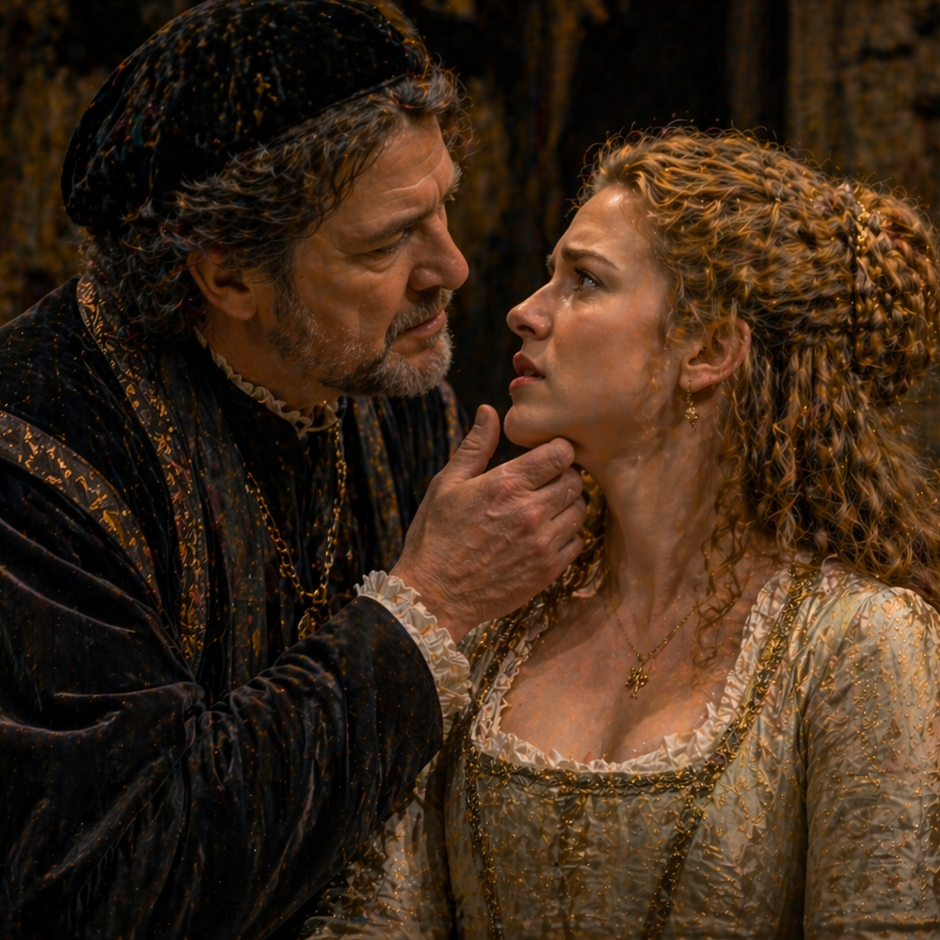
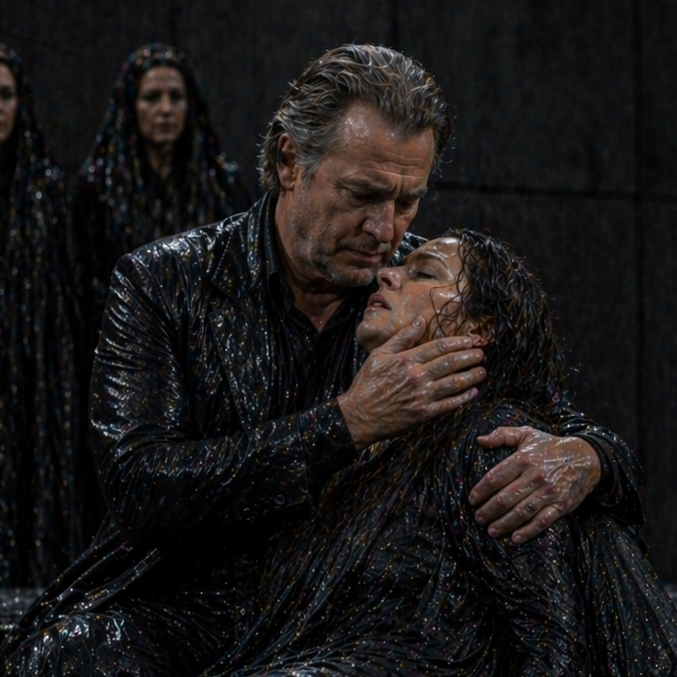
Three liberties are taken with the inherited myth, each in the direction the late style points. First, the backward look is not a failure of nerve. Orpheus turns deliberately, because he hears in Eurydike's voice that he is not leading her into the light but hauling her back into longing, and his gaze is the release. Second, the underworld does not suffer. The dead are at rest — the Will at peace — and his music wounds them by making them remember wanting. The famous condition is therefore not an arbitrary cruelty but a mercy: the look is desire, and what is desired is returned to suffering. Third, the women of Thrace are not maenads. They are mourners who need song the way the starving need bread, and his silence is, to them, a burying of bread. The violence, when it comes, is grief with nowhere to go.
The orchestral conceit governs the whole. In the first act the orchestra is the world. In the second act the bowed strings fall silent — the underworld has no strings, because the string is the lyre and the lyre is life — and they return only on the climb back toward the light, desk by desk, like blood returning to a limb. In the third act the orchestra is disassembled: no instrument that falls silent plays again. The opera ends smaller than it began, and the audience must hear it shrinking, until what remains is a single string sounded by no hand, and after that, silence that is written into the score, conducted, and held.
This is the third panel of a speculative late catalogue: Die Nacht, the opera of one voice; Sâvitrî, the opera in which silence is a character; Das Ende der Musik, the opera in which silence is the destination. None of the three was sketched. All three are completions of a tendency, not of a document.
Personen
ORPHEUS, der Sänger (tenor)
EURYDIKE, seine Braut (soprano)
PERSEPHONE, Königin der Tiefe, die den Frühling erinnert (contralto)
DER HÜTER DER SCHWELLE (bass)
DAS HAUPT (the same tenor, unseen)
Die Stimmen der Dinge (offstage chorus, wordless until the third act)
Die Toten (chorus, second act)
Die Frauen von Thrakien (women's chorus, third act)
Vom Orchester
Das Saitenspiel — the lyre-figure: a rising arpeggio in the harp, doubled by strings, from which all of Orpheus' music grows. When it inverts and falls, the work is ending.
Der Blick — the look: two chords, the second of which never arrives where the first one promises. It resolves once in the opera.
Die Tiefe — the deep: low brass and contrabassoon, less a theme than a floor under the harmony. In the second act it is everywhere. In the third act it is gone, which is worse.
Das Verstummen — the falling-silent: not a motive but a procedure. An instrument plays a figure one final time, incomplete, and does not play again. The procedure begins in the third act and is the third act.
In the second act the bowed strings of the pit do not play. The only string instrument heard in the underworld is the harp — the lyre — and its sound there is marked in the score as fremd: foreign.
Erster Aufzug
Before the curtain: das Saitenspiel, alone in the harp, once. Then again, with strings. Then a third time, and the whole orchestra opens out of it like a landscape out of a single path. The curtain rises during this third statement.
A high meadow, early light. The wood at the back, the sound of the river below. ORPHEUS sits on a fallen stone, the lyre on his knee, tuning it. The tuning is written into the score: the orchestra tunes itself around him, settling toward his pitch. Everything onstage is slightly turned toward him — the design is directed to make this almost unnoticeable, and unmistakable.
Erste Szene
Tag, beginne.
Day, begin.
was klingt, das lebt;
was lebt, das hört.
So halten wir die Welt:
ich singe sie,
sie hört sich zu.
what sounds, lives;
what lives, listens.
So we hold the world:
I sing it,
it listens to itself.
He plays. The Stimmen der Dinge answer from all sides — wordless, a slow bright chord that follows his harmony like grass following wind. The score directs: the chorus must never be locatable. It comes from the wood, the river, the stones, the house.
war Stein nur Stein.
Nun weiß der Stein,
dass er schweigt,
und sein Schweigen ist Antwort.
stone was only stone.
Now the stone knows
that it is silent,
and its silence is answer.
ging der Fluss nur fort.
Nun geht er fort
und nimmt ein Lied mit
und kommt als Regen wieder.
the river only went away.
Now it goes away
and takes a song with it
and comes back as rain.
Light grows. The Saitenspiel passes through the orchestra, section to section, as if the morning itself were learning it.
sing ich nicht den Dingen.
Heute kommt sie
durch das hohe Gras,
und alles, was ich je gesungen,
war nur Stimmen-Üben
für ihren Namen.
I do not sing to the things.
Today she comes
through the tall grass,
and everything I ever sang
was only the practicing of a voice
for her name.
Zweite Szene
EURYDIKE enters through the meadow, unhurried. The orchestra does something it has not yet done: it plays a figure he did not give it — a small falling phrase, hers. The score marks it: the first music in the opera that Orpheus did not make.
Der Morgen ist gestimmt.
Ich hörte dich am Fluss schon:
das Wasser ging im Takt.
The morning is tuned.
I heard you from the river already:
the water moved in time.
Hier in der Mitte
ist er am stillsten,
wie im Aug des Sturms.
Here at the center
it is most still,
as in the eye of the storm.
weiß ich nicht mehr,
wo ich ende
und der Klang beginnt.
Ist das die Liebe,
oder ist das die Musik?
I no longer know
where I end
and the sound begins.
Is that love,
or is that music?
Das ist die Liebe:
eine Saite,
zwei Enden,
ein Ton.
This is love:
one string,
two ends,
one tone.
Wer ihn anschlägt, wissen wir nicht.
Wer ihn aushält, sind wir.
Who strikes it, we do not know.
Who sustains it, is us.
They stand a moment in the figure the orchestra holds for them. Then EURYDIKE breaks gently away, toward the meadow's edge.
Ich will es von weitem hören,
wie man ein Haus von weitem sieht,
eh man darin wohnt.
I want to hear it from a distance,
the way one sees a house from a distance
before one lives in it.
She walks out into the tall grass, upstage, in full view. ORPHEUS turns downstage, toward the light, and lifts the lyre. He does not watch her go. The score directs: from this moment to the end of the scene, he must never look upstage.
Dritte Szene
The wedding song. It is the largest music of the act, and it is built so that the audience cannot give it their whole attention: beneath it, almost at once, the contrabassoon begins a low slow line — die Tiefe, the first time — moving through the grass of the orchestra the way the serpent moves through the grass of the stage. The Stimmen der Dinge see it. Their bright chord begins to fray into warning. ORPHEUS, singing, hears only consonance: his own music is too bright to hear through.
ihr Wege, blüht euch zu.
Was ich je sang, war Suche:
nun sing ich, was ich fand.
you roads, bloom yourselves closed.
Whatever I sang was searching:
now I sing what I found.
band ich zur Probe nur:
Wind an den Wald, den Stein an den Weg —
heut bind ich Hand an Hand.
I bound only as a trial:
wind to the wood, stone to the road —
today I bind hand to hand.
Upstage, in full view of the house and unseen by him: EURYDIKE stops. Looks down into the grass. Steps back once. The low line in the contrabassoon rises a half-step. She falls — simply, without cry, into the tall grass, which closes over her. The Stimmen der Dinge tear open into a dissonance that ORPHEUS, reaching the song's highest note, takes for his own harmony's strength.
dies eine stürbe nie:
der Ton, der dich gefunden —
er hält dich. Halte ihn.
this one would never die:
the tone that found you —
it holds you. Hold it.
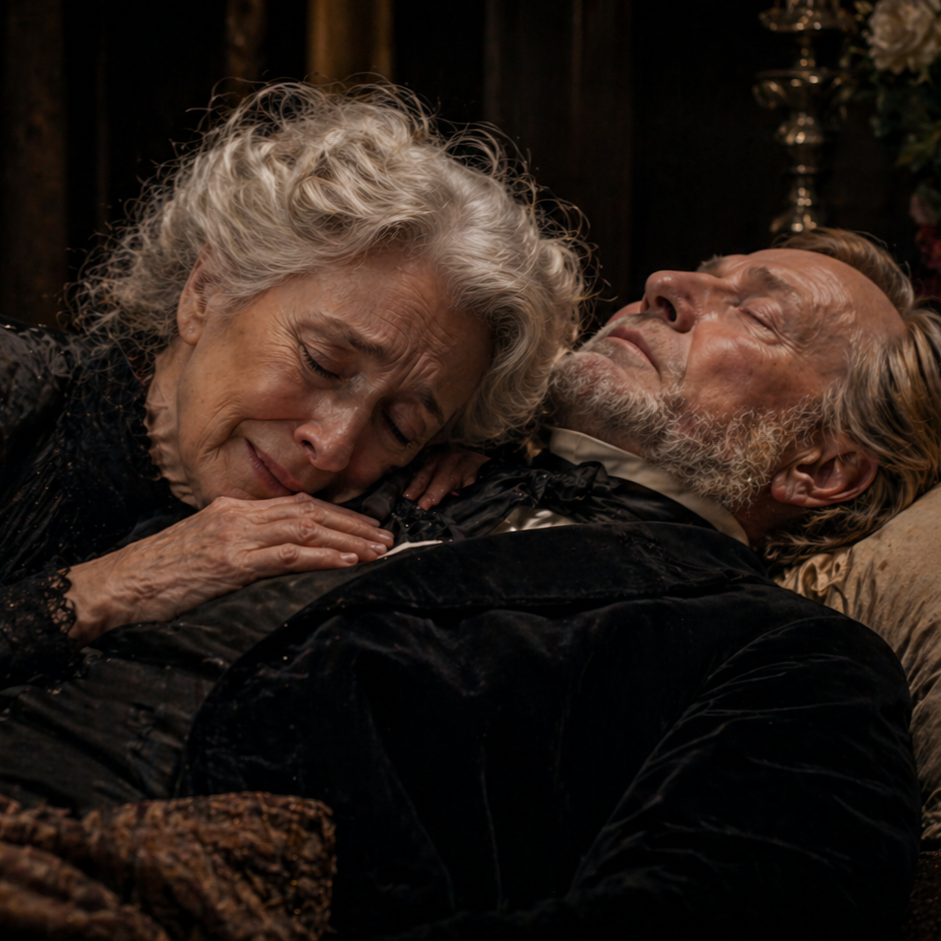
The song ends. Silence — the first real silence of the opera. He lowers the lyre, happy, breathing. He waits for her answer from the meadow. None comes. The orchestra does not play. He turns upstage.
Nothing. He walks into the grass. The orchestra stays silent; only now, too late, far too clear, the contrabassoon finishes the serpent's line and stops. He finds her. The score forbids a cry: the direction reads — he has spent his whole life answering everything with sound; now, for the first time, he has none. He kneels out of sight in the grass. Long pause.
Vierte Szene
He rises into view, carrying her. He lays her down on the fallen stone where he tuned the lyre. The light has not changed; the score remarks on this with the direction: the day is unbearably still the same day.
Alles still.
Ich sang, und der Tod
ging unter meinem Singen
wie ein Dieb durch ein helles Haus.
Everything still.
I sang, and death
walked beneath my singing
like a thief through a bright house.
Ihr Rufen war leise.
So hat mein Reichtum
mich arm gemacht.
Her calling was quiet.
So my riches
have made me poor.
The Stimmen der Dinge begin, very low, a mourning sound. He lifts his head.
Schämt euch nicht:
auch eure Tränen
habe ich euch gesungen.
Ich bin allein
im eigenen Echo.
Do not be ashamed:
even your tears
I sang into you.
I am alone
inside my own echo.
die Bäume beugt
und Tiere zähmt
und Flüsse hält,
wenn sie das Eine nicht vermag:
halten, was ich liebe?
that bends trees
and tames beasts
and holds rivers,
if it cannot do the one thing:
hold what I love?
He stands. The Saitenspiel begins again in the harp — but in the minor, and lower, as if the figure itself had aged. His next lines are marked: not despair. Resolve, which is worse to watch.
Wo sie ist, dort singe ich.
Hat mein Lied die Steine bewegt:
es bewege den letzten Stein,
das Tor, das nur nach innen geht.
Where she is, there I will sing.
If my song has moved the stones:
let it move the last stone,
the gate that opens only inward.
als die Saiten
und ihren Namen.
Mehr war ich nie.
but the strings
and her name.
More I never was.
He lifts the lyre and walks upstage, past where she lies, into the wood. The transformation begins: the scene does not change — it sinks. The wood rises, or the floor descends; the light drains not to darkness but to a darkness with weight. Die Tiefe enters the full low brass for the first time. One by one, the bowed strings of the pit stop playing — not the Verstummen yet; they will return — until only winds, brass, and the harp are left, and the harp sounds suddenly foreign in the world it is entering. The curtain falls slowly during the descent, the only act-curtain in the work.
Zweiter Aufzug
No prelude. The curtain rises on sound already in progress, as if the music of the deep had been continuing whether or not anyone listened: die Tiefe in the low brass and contrabassoon, slow, without pulse. No bowed strings; they sit silent in the pit, visible, instruments lowered. The score directs that the audience should be able to see they are not playing.
The underworld. Not a cavern: a stillness with a floor. Grey light without source or shadow. DIE TOTEN are arranged across the depth of the stage, not as a crowd but as a landscape — seated, lying, standing, each alone, none turned toward any other. They do not suffer. This must be unmistakable. The horror of the scene, the score insists, is that there is no horror in it.
Erste Szene
Wir wollten lange,
nun wollen wir nicht mehr.
Das Wollen liegt oben,
bei den Lebenden,
im Licht, das wehtut.
We wanted for a long time,
now we want no more.
Wanting lies above,
with the living,
in the light that hurts.
Das Waren ist abgelegt
wie ein nasses Gewand.
Hier ist kein Gestern,
hier ist kein Morgen:
hier ist das stille Heute,
das niemals heute heißt.
The having-been is laid aside
like a wet garment.
Here is no yesterday,
here is no tomorrow:
here is the still today
that is never called today.
Far off, approaching, impossibly: das Saitenspiel. The harp. In this acoustic it sounds — the score uses the word — fremd: foreign. A sound from the country of wanting. ORPHEUS enters along the back of the stage, small in the depth, playing as he walks.
Es klingt.
Wer bringt das Sehnen
in das Haus der Stille?
There is sounding.
Who brings longing
into the house of stillness?
o weh, wir hatten
das Vergessen vergessen.
Es riecht nach Wiesen.
Es schmeckt nach Namen.
Nimm es fort.
o woe, we had
forgotten forgetting.
It smells of meadows.
It tastes of names.
Take it away.
Das Fortnehmen ist nicht meine Kunst.
Meine Kunst ist das Bringen:
ich bringe die Welt,
wohin ich gehe.
Verzeiht, ihr Toten.
Ich suche eine,
die noch nicht lange ruht.
Taking-away is not my art.
My art is bringing:
I bring the world
wherever I go.
Forgive me, you dead.
I am looking for one
who has not long been resting.
Zweite Szene
PERSEPHONE has been onstage the whole time, indistinguishable from the dead. Now she rises, and the light finds her without growing. She is the only figure in the deep who turns her face toward the sound.
Die andern leiden am Klang.
Ich nicht.
Ich bin die Königin hier
und halb von oben:
jedes Jahr vergesse ich die Wiesen,
jedes Jahr im Dunkeln,
und jedes Jahr im Hellen
vergesse ich das Dunkel.
Ich bin das Tor, in einem Leib.
The others suffer at the sound.
Not I.
I am the queen here
and half from above:
every year I forget the meadows,
every year in the dark,
and every year in the light
I forget the dark.
I am the gate, in a body.
es riecht nach Regen.
Sing, Sänger.
Sing mir den Regen zu Ende,
und ich will hören,
was du willst.
it smells of rain.
Sing, singer.
Sing the rain to its end for me,
and I will hear
what you want.
eine einzige
aus deinem ganzen Volk.
Was ich will, ist ungeheuer:
dass der Tod sich irre
ein einziges Mal.
one single one
out of all your people.
What I want is monstrous:
that death should err
one single time.
Sie kam zu früh.
Mein Lied war laut,
ihr Rufen leise —
gib sie mir wieder,
und ich verspreche dir:
ich singe fortan leiser.
She came too soon.
My song was loud,
her calling quiet —
give her back to me,
and I promise you:
from now on I will sing more softly.
He plays. The aria is marked: he sings the upper world — rain, grass, the river, the wedding morning — and as he sings, the dead, against their own peace, begin to turn their faces toward him, one by one, like stones turning. PERSEPHONE weeps without sound. The score notes: in the underworld, weeping is dry; the orchestra supplies the water, a slow figure in the harp like dripping.
Du hast die Ruhe verwundet,
und die Wunde heißt Erinnern.
Nimm sie.
Nimm sie schnell,
eh das ganze stille Volk
wieder zu wollen beginnt.
You have wounded the rest,
and the wound is called remembering.
Take her.
Take her quickly,
before this whole still people
begins again to want.
Dritte Szene
DER HÜTER DER SCHWELLE steps out of the dark at the back — or the dark at the back becomes him. Bass. He sings over die Tiefe alone: the floor of the harmony, nothing else.
Doch höre das Gesetz,
das älter ist als wir,
älter als das Haus, das ich hüte:
But hear the law
that is older than we are,
older than the house I guard:
der Wille ist Hunger,
der Hunger ist Welt.
Was du erblickst, begehrst du.
Was du begehrst, ziehst du
zurück in den Schmerz.
the will is hunger,
the hunger is world.
What you behold, you desire.
What you desire, you pull
back into pain.
bis das Licht sie ansieht.
Erst wenn der Tag sie berührt,
ist sie wieder dem Tage gegeben.
Bis dahin
gehört sie der Schwelle,
und die Schwelle erträgt
keinen Blick.
until the light looks at her.
Only when the day touches her
is she given again to the day.
Until then
she belongs to the threshold,
and the threshold endures
no gaze.
Ich trug die Saiten durch das Tor,
das nur nach innen geht:
was ist ein Nacken,
der sich nicht wendet,
gegen ein Tor aus Stein?
I carried the strings through the gate
that opens only inward:
what is a neck
that does not turn,
against a gate of stone?
das man noch nicht gebrochen hat.
that one has not yet broken.
Vierte Szene
The ascent. The longest transformation in the work. The stage climbs — or the deep sinks away behind them. ORPHEUS walks downstage-forward through changing levels; EURYDIKE follows at a fixed distance, half-lit, her face never fully visible to the audience either: the score extends the law to the house — we, too, do not see her until the light does.
And the strings return. One desk at a time, over many minutes, the bowed strings of the pit lift their instruments and re-enter, each entry marked in the score with a stage of the climb — like blood returning to a limb, like a season returning to a field. The effect must be physical: the world is coming back.
bist du es, der da geht?
Ich sehe nur den Rücken
und den Weg.
is it you who walks there?
I see only the back
and the road.
Vor mir dein Schritt,
hinter mir die Ruhe.
Ich weiß nicht mehr,
welche von beiden
ich verlassen soll.
Before me your step,
behind me the rest.
I no longer know
which of the two
I am supposed to leave.
So klingt keine Lebende.
So klingt keine Tote.
So klingt eine,
die man zerrt.
No living woman sounds like that.
No dead woman sounds like that.
That is the sound of someone
being dragged.
ich erinnere den Morgen —
o weh, ich erinnere:
das ist der Schmerz,
von dem die Stille mich
schon einmal geheilt hat.
Musst du mich zweimal
durch das Sterben führen,
einmal hinab
und einmal hinauf?
I remember the morning —
o woe, I remember:
this is the pain
the stillness had already
healed me of once.
Must you lead me twice
through dying,
once downward
and once up?
He stops. The strings, mid-crescendo, are cut off — all of them at once. The silence is the Blick-motive's first chord, held.
Ich höre, was mein Lied dir antut.
Ich führe dich nicht ins Licht:
ich zerre dich ins Sehnen.
Mein ganzes Singen war ein Greifen,
und du bist das Letzte,
wonach ich greife.
I hear what my song is doing to you.
I am not leading you into the light:
I am hauling you into longing.
All my singing was a grasping,
and you are the last thing
I am grasping for.
He turns. Deliberately, slowly, in full light. The Blick-motive's second chord arrives — and for the only time in the opera, it resolves. The score marks the direction: this is not the breaking of the law. It is the keeping of a higher one.
ich sehe dich an.
Nicht weil ich schwach bin:
weil ich dich liebe
über den Hunger hinaus.
Geh zurück in die Ruhe.
Mein Blick ist kein Greifen.
Mein Blick lässt los.
I look at you.
Not because I am weak:
because I love you
beyond the hunger.
Go back into the rest.
My look is not a grasping.
My look lets go.
hast du mich ganz gesungen.
have you sung me whole.
She is gone — not snatched: released. The light that held her stays a moment on the empty place. ORPHEUS stands alone on the threshold, the lyre hanging from his hand, his back to the deep, his face toward the unbearable upward way. The harp tries the Saitenspiel once: he does not take it up. No curtain; the light contracts to him and goes.
Dritter Aufzug
The meadow of the first act, a season later. The same fallen stone. The same river below. The light is the same morning light, and the score directs that this must be exact: the cruelty of the act is that the world has not changed. ORPHEUS sits where he sat at the opera's opening, the lyre beside him on the stone — not on his knee. He does not touch it. He has not touched it.
From this act's first measure, the procedure called das Verstummen governs the orchestra: any instrument that falls silent does not play again. The score lists, scene by scene, what is retired and never recalled. The audience is not told this. They are made to feel it.
Erste Szene
Die Stimmen der Dinge — and they have words now. The direction reads: while he sang, the things had no need of words; his silence makes them speak. It is the first consequence of the end of music, and the gentlest.
Der Morgen weiß nicht,
wie er anfangen soll.
The morning does not know
how it is supposed to begin.
und nimmt nichts mit
und kommt als nichts wieder.
Der Stein ist wieder nur Stein.
Wir hatten Stimmen in deiner Stimme.
Wo sollen wir wohnen?
and takes nothing with it
and comes back as nothing.
The stone is only stone again.
We had voices inside your voice.
Where are we supposed to live?
was das Lied verschweigt.
Jeder Ton ist Hunger,
jede Weise will,
und das Wollen ist die Wunde.
what the song keeps silent.
Every tone is hunger,
every melody wants,
and the wanting is the wound.
zusammen in den Schmerz.
Ich band den Wind an den Wald:
nun zerrt der Wald am Wind.
Ich band das Herz an das Herz:
ihr wisst, wohin das führt.
together into the pain.
I bound the wind to the wood:
now the wood tears at the wind.
I bound heart to heart:
you know where that leads.
das andere Lied.
Es hat keine Töne.
Ich habe es unten gehört,
im Haus, wo nichts mehr will.
Es heißt: Genug.
the other song.
It has no tones.
I heard it below,
in the house where nothing wants anymore.
It is called: Enough.
During this speech, quietly, the first retirements: the piccolo plays a fragment of the Saitenspiel, incomplete, and is silent; then the second oboe; then the triangle, a single struck note that the score marks — its whole part in this act. None of them plays again.
Zweite Szene
DIE FRAUEN VON THRAKIEN enter from all sides — not a horde: women in mourning clothes, carrying the things mourners carry. They have buried this season's dead without him. The score forbids frenzy from beginning to end of the scene: the direction reads — there are no maenads in this work; there is only grief that has been refused its door.
Wir haben dich gesucht
den ganzen Sommer der Gräber.
Unsere Toten liegen unbesungen.
We have looked for you
all this summer of graves.
Our dead lie unsung.
den Weg aus der Brust nicht.
Sie geht nach innen
und gräbt dort weiter.
Sing, oder wir ersticken.
cannot find the way out of the breast.
It turns inward
and goes on digging there.
Sing, or we suffocate.
als mein Schweigen.
Nehmt es.
Es ist das Reifste, was ich habe.
than my silence.
Take it.
It is the ripest thing I have.
Wir haben Schweigen genug:
es liegt in der Erde,
wir haben es selbst hineingelegt.
Vom Schweigen der Erde
zum Schweigen des Sängers —
wohin sollen wir treten?
We have silence enough:
it lies in the earth,
we laid it in there ourselves.
From the silence of the earth
to the silence of the singer —
where are we supposed to stand?
Über das Sehnen hinüber.
Ich bin den Weg gegangen:
er ist gangbar.
Across, beyond the longing.
I have walked the way:
it can be walked.
und er begräbt sie
vor unseren Augen,
wie man vor Hungernden
das Brot vergräbt.
and he buries it
before our eyes,
as one buries bread
before the starving.
der hat den Hunger gemacht.
Wer das Lied hat und es verschweigt,
der hat die Stille gemacht,
und die Stille
frisst unsere Kinder bei Nacht.
has made the hunger.
He who has the song and withholds it
has made the silence,
and the silence
eats our children at night.
Ich habe euch das Hören gelehrt
und nehme euch das Gehörte.
Das ist nicht zu vergeben.
Ich bitte auch nicht.
I taught you hearing
and I take from you the heard.
That is not to be forgiven.
Nor do I ask it.
wenn man die Tür ihr zuhält.
Ich halte die Tür.
Ich halte sie aus Liebe zu.
Das werdet ihr nie glauben,
und ihr habt recht,
es nicht zu glauben.
when its door is held shut.
I am holding the door.
I hold it shut out of love.
You will never believe that,
and you are right
not to believe it.
They close around him. The stage darkens from the edges inward; the Stimmen der Dinge cry out — the only cry the things utter in the whole work. What happens is not shown: the women's circle, the lifted arms, then the bodies hiding everything, in the manner of a tide covering a stone. In the orchestra: das Saitenspiel, inverted, falling, in the full remaining ensemble — and during the fall the retirements come fast now: horns, then trumpets, then all the upper winds, each with its incomplete fragment, each silent forever. The circle of women opens. The stage is empty where he was. The lyre lies on the fallen stone. The women are still. The direction reads: they have not found the door either. They carry what they carry to the river — and the lyre with it — and are gone.
Dritte Szene
The river, below the meadow: the front of the stage becomes the bank, the house itself the water — the score directs that the river is played toward the audience. Dusk going to dark. What remains of the orchestra: the low strings, one harp, one clarinet, the contrabassoon. Nothing else will sound again.
On the water — unseen, or barely: a light moving slowly with the current — DAS HAUPT. The same tenor, offstage, unaccompanied. The voice should arrive as if the river itself had learned it.
Was vom Singen übrig ist,
trägt der Fluss.
Er hat es einst von mir gelernt:
nun lerne ich von ihm
das Fortgehen.
What is left of singing,
the river carries.
It learned it from me once:
now I learn from it
the going-away.
nicht Werbung mehr,
nicht Macht, nicht Greifen:
nur noch der Ton,
der vor den Liedern war.
Ich gebe ihn zurück.
no more wooing,
no power, no grasping:
only the tone
that was before the songs.
I give it back.
The clarinet plays its last fragment and is silent. Then the contrabassoon: die Tiefe, one final time, unfinished — and silent. The low strings hold a single tone under the voice.
Eurydike —
Eu — ry — di — ke —
Eurydike —
Eu — ry — di — ke —
The name itself disassembling, syllable by syllable, until it is vowel, until it is breath. The low strings cease — bows lifted, visibly. The harp does not play. On the bank, on the fallen stone: the lyre. A wind crosses the stage — the score gives the wind a cue, like a player — and one string of the lyre sounds. Once. Von keiner Hand: by no hand. It is the last note of the opera.
Hier endet die Musik. Die Stille wird dirigiert.
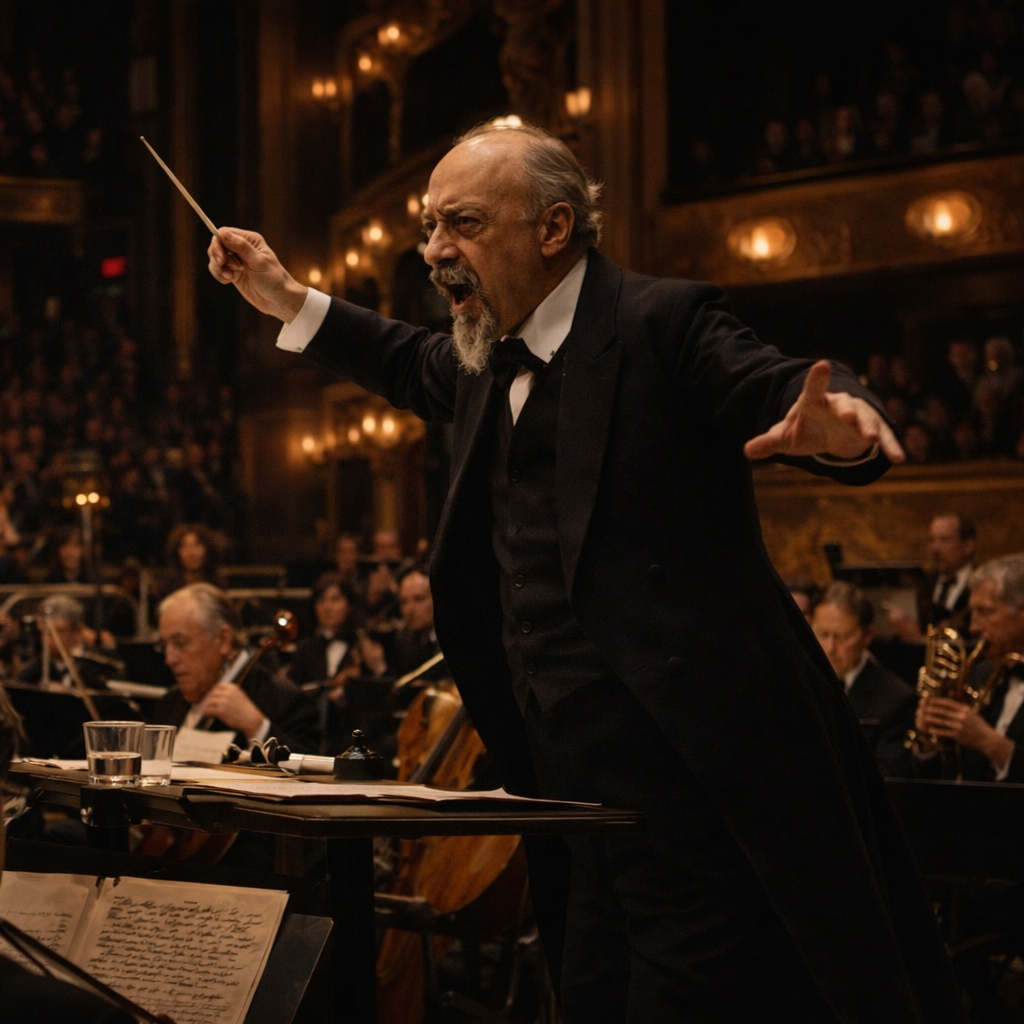
The silence is written into the score as a numbered measure with a fermata. It belongs to the work. It is conducted. It is to be endured, not filled. The conductor's arms remain raised. No one onstage. The light stays on the river and on the lyre, and holds, and holds, until the house can no longer bear it; then, more slowly than any music could, dark. The curtain does not fall.