When Daylight Is the Enemy: On Nacht
das Wort / the word:die Nacht (f.), pl. die Nächte
Aussprache / pronunciation: NAKHT
Wortart / part of speech: Noun, feminine
Register: Universal, among the most basic words in German, appearing at every level from children's bedtime to the highest reaches of Romantic philosophy. Its very ordinariness is part of what makes Wagner's use of it so radical: he takes the simplest word for a natural phenomenon and charges it with metaphysical weight it cannot contain.
Was das Wort wirklich bedeutet / What the word actually means
Nacht means night. There is nothing complex about this translation. Night is night in German as in English. The period of darkness between sunset and sunrise, the time when the world withdraws from visibility, when the body is supposed to rest, when ordinary activity suspends. Every child knows Gute Nacht, good night, as among the first phrases in any language. The word is foundational and simple.
What Wagner does with it in Tristan und Isolde is neither simple nor foundational. He takes this most ordinary of words and inverts its entire cultural logic. In Tristan, night is not the absence of day, not the time between activities, not rest, not darkness as a neutral physical condition. Night is the only genuine state. Day, der Tag, is the intrusion. Light is the aggressor. The social world, with its courts and obligations and hierarchies and marriages of political convenience, is the world of Tag. And the world of Tag is what Tristan and Isolde are trying to escape.
The Love Duet's central aria, O sink hernieder, Nacht der Liebe, O descend, night of love, is an invocation, not a description. They are calling night down onto themselves the way you might draw a curtain or shut a door. Not to go to sleep, but to be sealed off from everything that keeps them apart. Night, in Tristan, is shelter. It is the condition under which the self can dissolve into the other without social consequence, without the demands of daylight identity, without the scrutiny of a world that knows who they are supposed to be. This inversion, night as the real, day as the false, is one of the most consequential ideas in European Romanticism, and Tristan und Isolde is its most fully realized musical expression.
Die Etymologie / Etymology
Nacht comes from Old High German naht, from Proto-Germanic nahts, from the Proto-Indo-European root nókʷts. The word is among the most stable in all Indo-European languages: Latin nox (genitive noctis), Greek nyx, Sanskrit nakt, Russian noch, English night, all from the same ancient root. Night was one of the first things human beings needed a word for, and the family of words that resulted has barely changed in structure across five thousand years.
The German Nacht is feminine, die Nacht, where the English night is grammatically neutral. In German, the femininity of Nacht is not incidental. It participates in a broader cultural and literary tradition in which night is female and day is male, where the feminine night is associated with interiority, mystery, and the dissolution of boundaries, and the masculine day with clarity, order, and the demand for defined identities.
The plural die Nächte (nights) appears in a range of culturally significant compounds and phrases. The Walpurgisnacht (Walpurgis Night) is the eve of May 1st, associated with witches, spirits, and the breakdown of ordinary order. Mitternacht (midnight, literally mid-night) is the temporal marker of the night's deepest point. Nachtmusik, night music, names a specific character of musical composition. Mozart's Eine kleine Nachtmusik is not music about night but music that has the quality of night, the intimate, domestic, slightly secretive character of music made when the day is over.
Nacht und Tag: Die Romantische Umkehrung / Night and Day: The Romantic Inversion
In the classical and Enlightenment traditions, the association of day with truth, reason, and civilization, and night with irrationality, danger, and the suspension of moral order, was so firmly established as to be barely noticed as an assumption. The Platonic tradition placed the Good in the realm of light. The sun was the metaphor for the Form of the Good itself. Enlightenment thinkers spoke of Aufklärung, literally clearing-up, lightening, the dispelling of darkness, as the project of reason. Ignorance was darkness. Knowledge was light. The goal was maximum illumination.
The German Romantics reversed this. For Novalis, whose mystical prose-poems of the late 18th century established the Romantic Nacht as a major literary category, night was not the absence of light but the presence of something light obscures. His Hymnen an die Nacht (Hymns to the Night, 1800) is the foundational text. A young man mourning his dead beloved descends into grief and finds, in the darkness of the grave and the night, not horror but homecoming. Hinüber wall' ich, / und jede Pein / wird einst ein Stachel / der Wollust sein, I wander across, and every pain will one day be a spur of rapture. Night is where the beloved is. Night is where the self finds its true depth. Day is the superficial world of appearances.
Wagner read Novalis. He read Schopenhauer, for whom the will-to-live, the blind, insatiable striving force that constituted all reality, was best approached not through rational daylight consciousness but through the dissolution of individual consciousness that great music produced. He read the entire German Romantic tradition as a preparation for Tristan, and in Tristan he completed the Romantic inversion of night and day as a musical argument.
The Day/Night opposition in Tristan is not symbolic or metaphorical. It is structural. Act I takes place in daylight, on a ship, in the public world. The lovers drink what they believe is a death potion and find themselves in love. Or rather, find themselves acknowledging a love that was already there, that the social world had been suppressing. Act II takes place at night, in a garden, in the private world. The great Love Duet is possible because daylight has retreated. When Melot arrives with the torches and the court, he is not merely a villain. He is day arriving to destroy night. He is Tag reasserting itself over everything Nacht has permitted.
Act III is after night. Or more precisely, it is daylight without the redemption night promised. Tristan is wounded, delirious, waiting. He cannot re-enter night. The Liebestod offers a different resolution. The dissolution into death that night had promised but could not, in life, deliver.
Nacht in der Sprache / Night in the Language
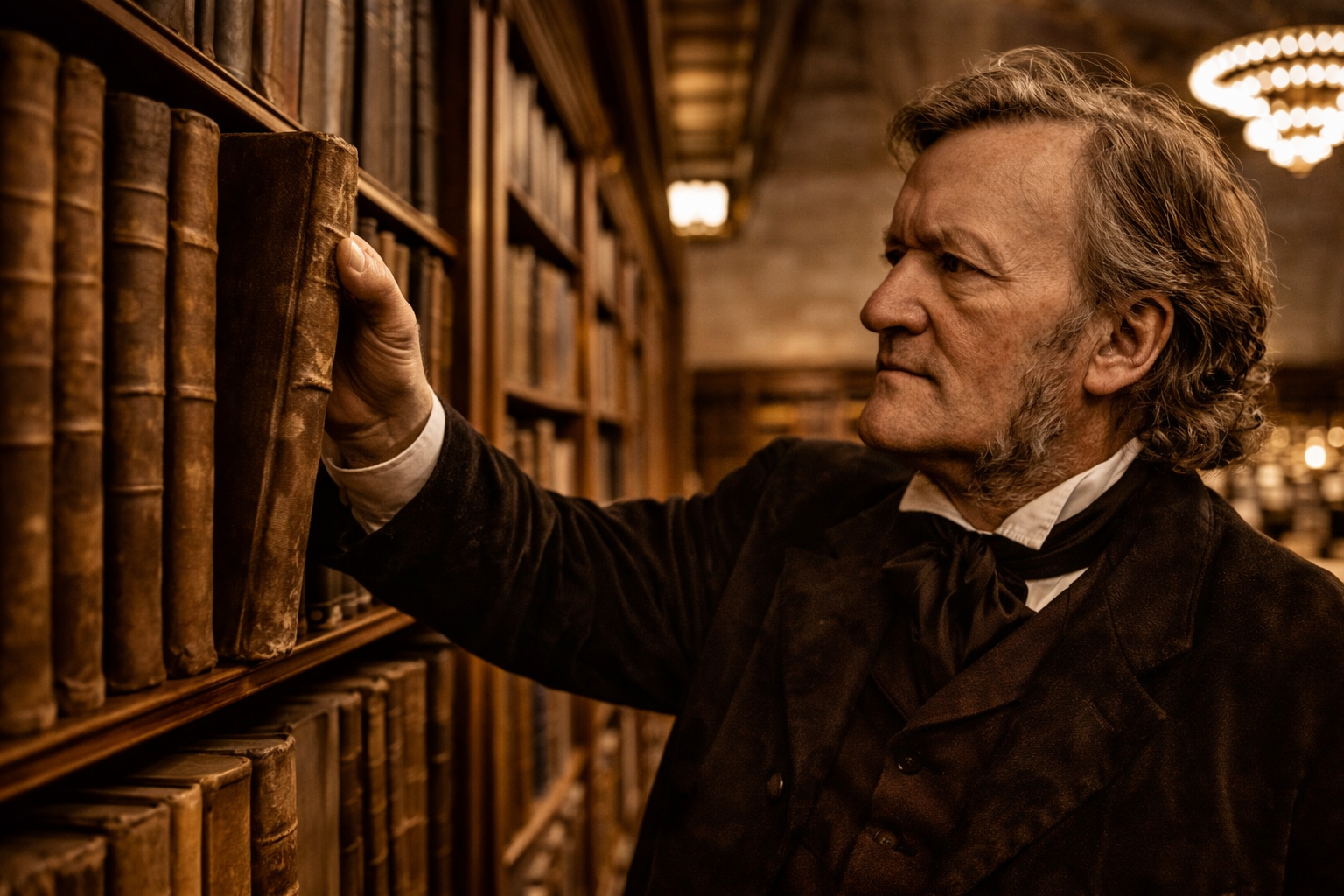
German has built an extensive vocabulary around Nacht that reveals how thoroughly the culture has organized itself around the night/day distinction:
die Nachtmusik, night music (intimate, private, the music of after-hours)
der Nachtfalter, moth (literally night-butterfly, the creature that navigates by darkness)
der Nachtschatten, nightshade (literally night-shadow, the deadly plant that flowers in darkness)
der Albtraum, nightmare (literally Elf-dream in older usage, the night's terror)
das Nachtleben, nightlife (the city's alternate world after dark)
die Mitternacht, midnight
nächtlich (adj.),nightly, nocturnal
übernachten (v.), to spend the night, to stay overnight (über + Nacht, to pass over a night somewhere)
die Dunkelheit, darkness (more literal than Nacht; the physical absence of light)
das Dunkel, the dark, the obscurity (both physical and metaphorical: im Dunkeln tappen, to grope in the dark, to be in the dark about something)
The phrase bei Nacht und Nebel, by night and fog, is a standard German idiom for secretive, covert operations: things done in darkness and obscurity, away from public view. It was the name the Nazis gave to a policy of making political prisoners disappear, Nacht-und-Nebel-Erlass, Night and Fog Decree, which loaded the phrase with historical horror it cannot now shed. German speakers carry this weight in the idiom. Nacht is never entirely innocent.
Der Tristan-Akkord: Nacht als Harmonie / The Tristan Chord: Night as Harmony
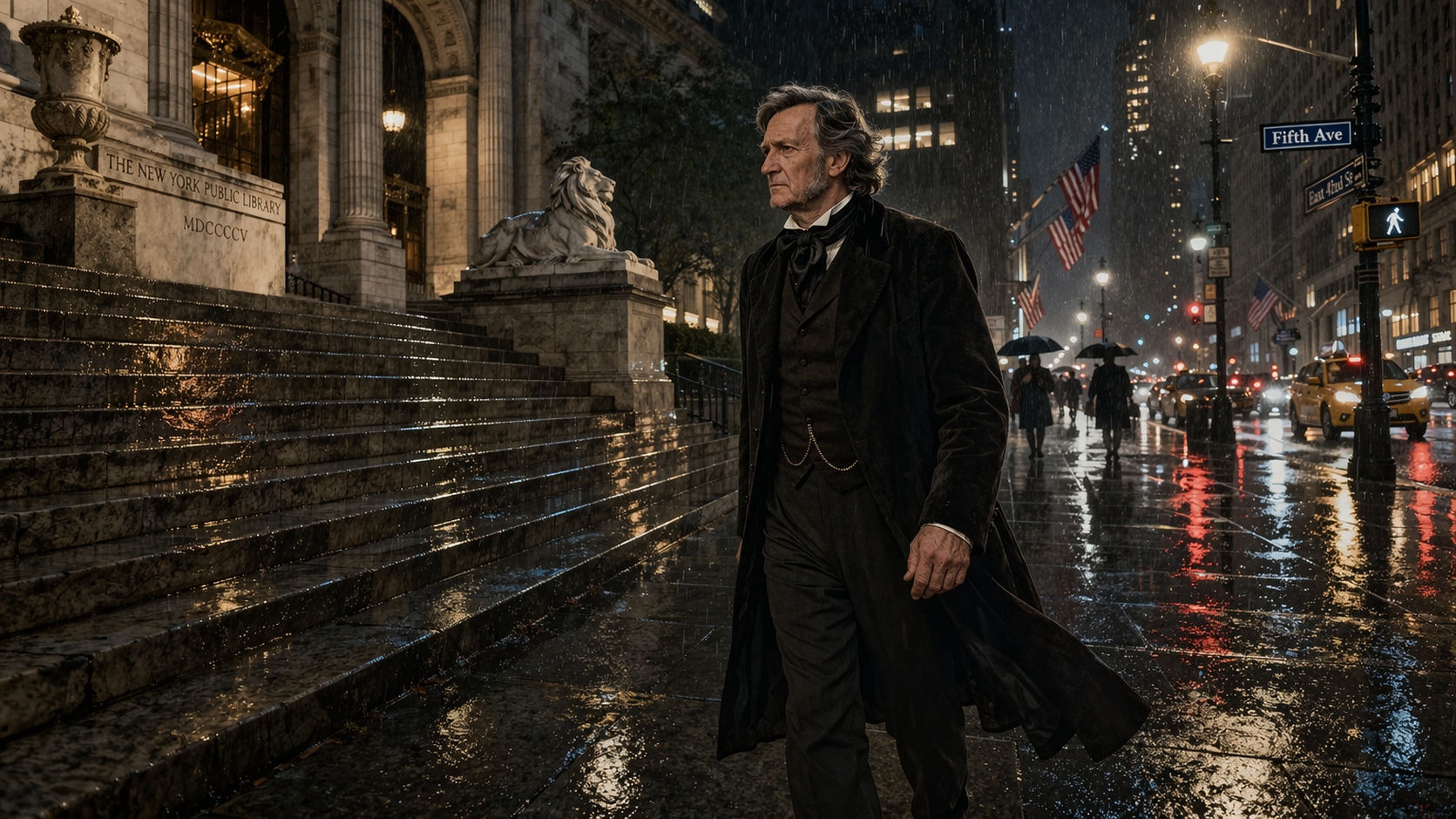
The most celebrated single sonority in the history of Western music is the opening chord of Tristan und Isolde: the so-called Tristan chord, which consists of the notes F, B, D-sharp, and G-sharp. It is not, in itself, particularly dissonant. What makes it extraordinary is what it does, or rather what it refuses to do. Resolve.
The chord creates an expectation of resolution that the opera systematically withholds for four and a half hours. Every time it sounds, it generates desire for a specific harmonic destination that is then denied, deferred, rerouted. The final resolution, the only genuine harmonic closure in the entire opera, arrives in the last bars of the Liebestod, in B major, after nearly five hours of deferral.
The chord is a musical embodiment of Nacht in the Romantic sense. Not darkness as mere absence of light, but darkness as the active condition of desire that cannot yet be satisfied, of consciousness hovering between states, of the self suspended at the edge of dissolution. The Tristan chord is not comfortable. It is not peaceful. It is the sound of wanting, of the tension between what is and what the harmony longs to be.
Wagner was working directly with Schopenhauer's aesthetics when he composed Tristan. For Schopenhauer, music was the most direct expression of the will, not a representation of the will, but the will itself made audible. The Tristan chord is the will made audible in its most naked form. Pure, unresolved, insatiable desire, suspended in sound. This is what Nacht means in the opera's most concentrated musical moment. The dark where the self cannot settle, where desire cannot close, where night offers shelter from the demands of day without offering the rest that ordinary night promises.
Grammatik und Gebrauch / Grammar and Usage
Die Nacht declines regularly as a feminine noun.
Key constructions:
in der Nacht, in the night, during the night
bei Nacht, by night, at nighttime
über Nacht, overnight
eines Nachts, one night (genitive construction, literary: eines Nachts verschwand er, one night he disappeared)
Nacht für Nacht, night after night
die ganze Nacht, all night long
es wird Nacht, night is falling (literally, it is becoming night)
The greeting: Gute Nacht, good night. The farewell that closes the day. In Tristan, this greeting has a different resonance: Brangäne's watch-song in Act II, sung from the tower while the lovers are in the garden below, is a kind of Gute Nacht that is also a warning: the night is passing, day is coming back, you will have to return to the world.
Verwandte Wörter / Related Words
nächtlich (adj.), nocturnal, nightly
die Dunkelheit, darkness, the dark
das Dunkel, the dark, obscurity
der Tag, day (the operative opposite in Tristan)
die Dämmerung, twilight, dusk (the threshold moment, neither day nor night, Götterdämmerung, twilight of the gods, takes this ambivalent moment as its title)
das Morgenrot, dawn (literally morning-red, the light that ends the lovers' night in Act II)
übernachten (v.), to spend the night
die Mitternacht, midnight
das Nachtleben, nightlife
bei Nacht und Nebel, by night and fog (secretively, covertly)
die Finsternis, darkness, obscurity (more absolute than Dunkelheit, biblical in register, Finsternis über der Tiefe, darkness upon the deep)
Die Verbindung zum Weg / Connection to the Walk
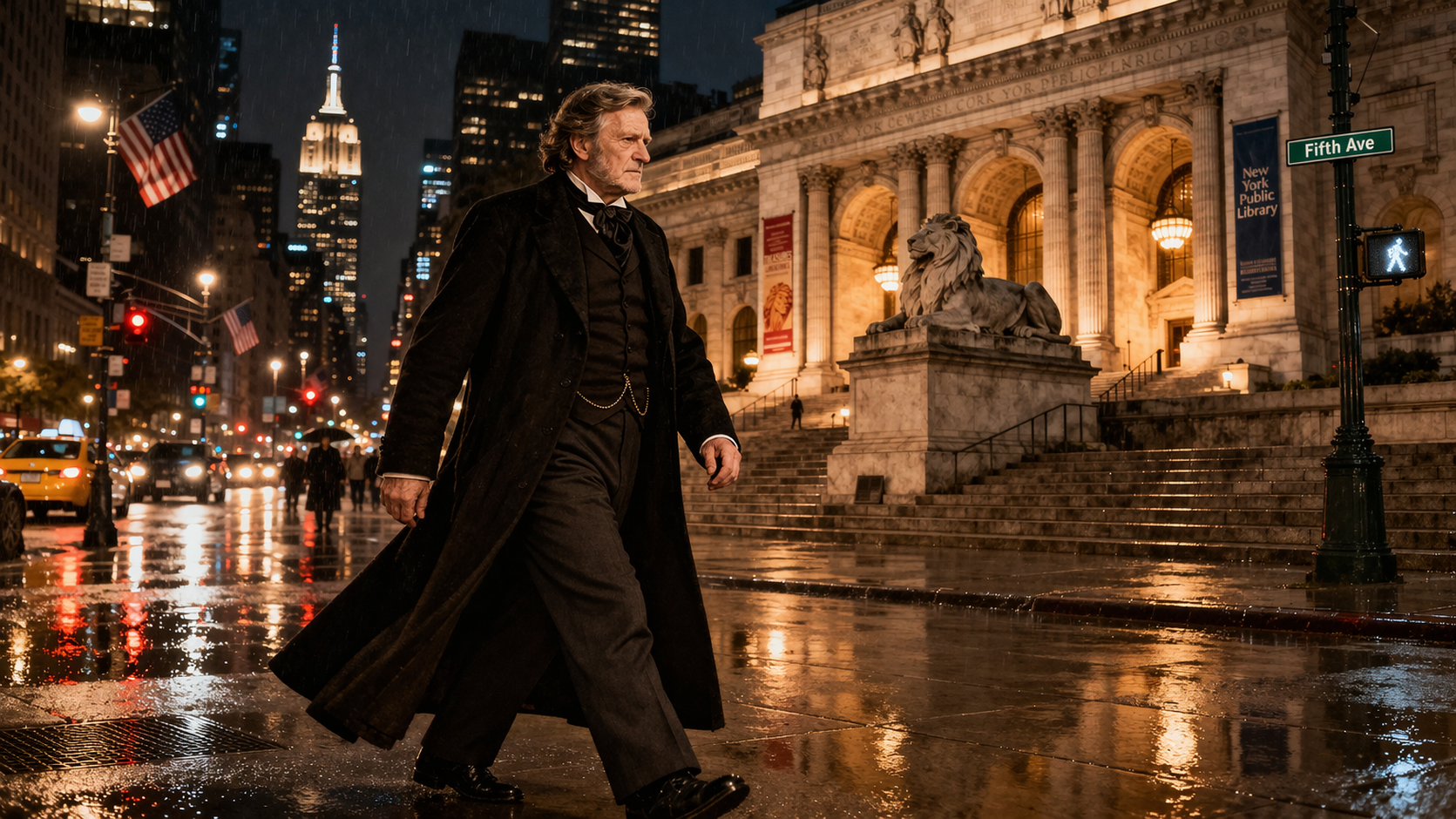
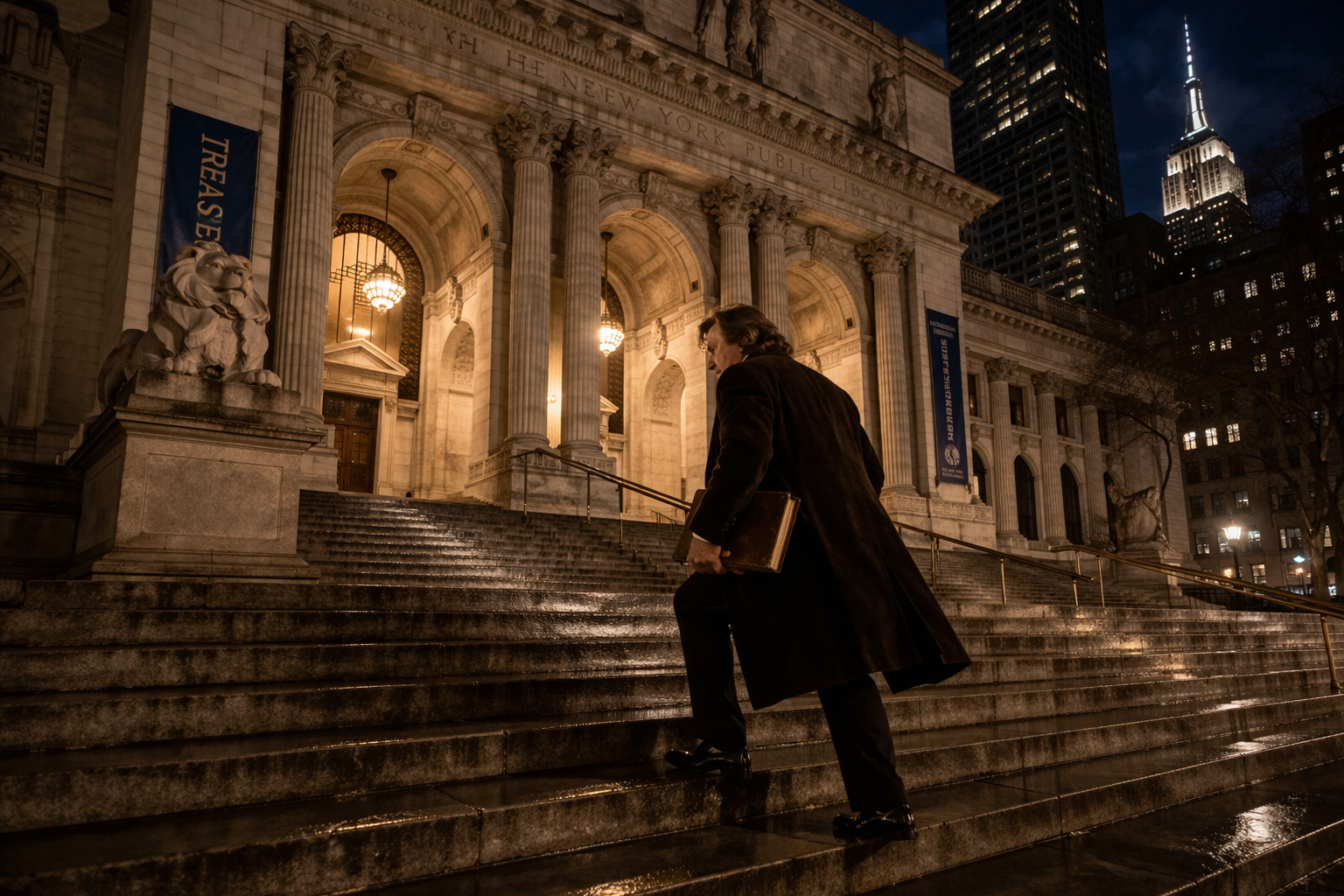
The April walk is the year's first fully interior circuit. No harbor, no park, no reservoir. The sites, the Rose Main Reading Room, the side chapels of St. Patrick's, the Met Cloisters, a subway platform, a dark bench somewhere in the city, are all enclosed, all contained, all spaces where the city's ambient noise is dampened and something resembling Nacht in the Romantic sense becomes available even in April daylight.
The walk's instruction to arrive in the evening, after sunset essential, is not atmospheric decoration. It is structural. The April walk only works in darkness, or approaching darkness, because Nacht in Tristan's sense is not just a time of day but a perceptual condition. The state in which ordinary categories relax, in which the social world's demands recede, in which the self can sit with unresolved desire without the pressure to act on it or suppress it.
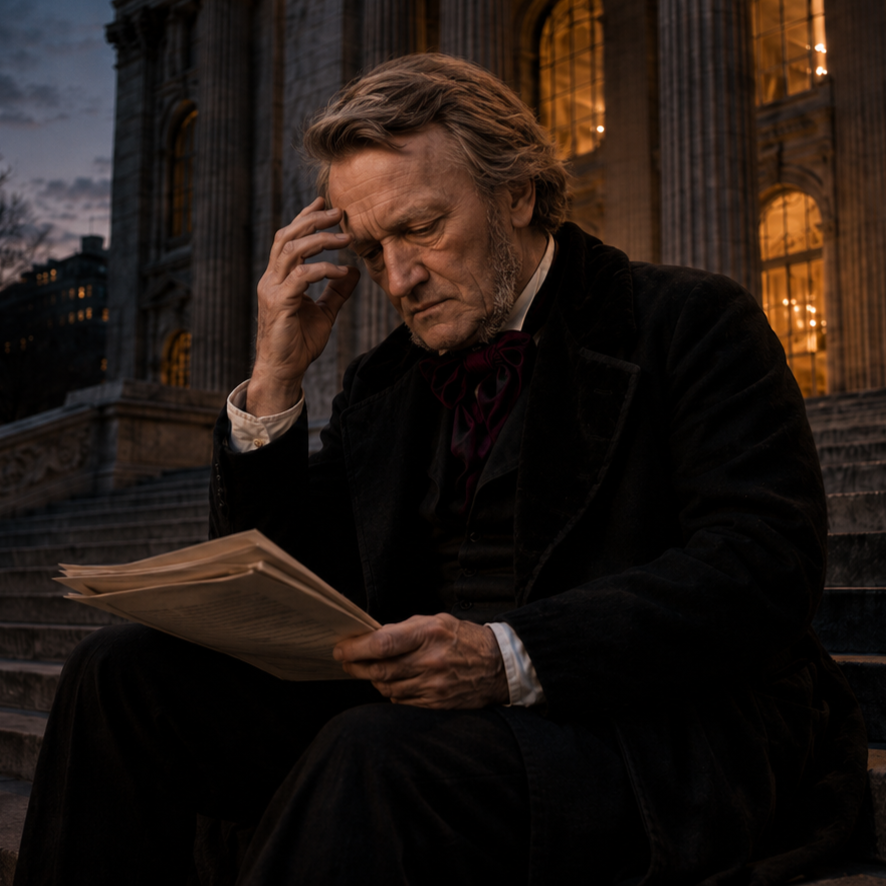
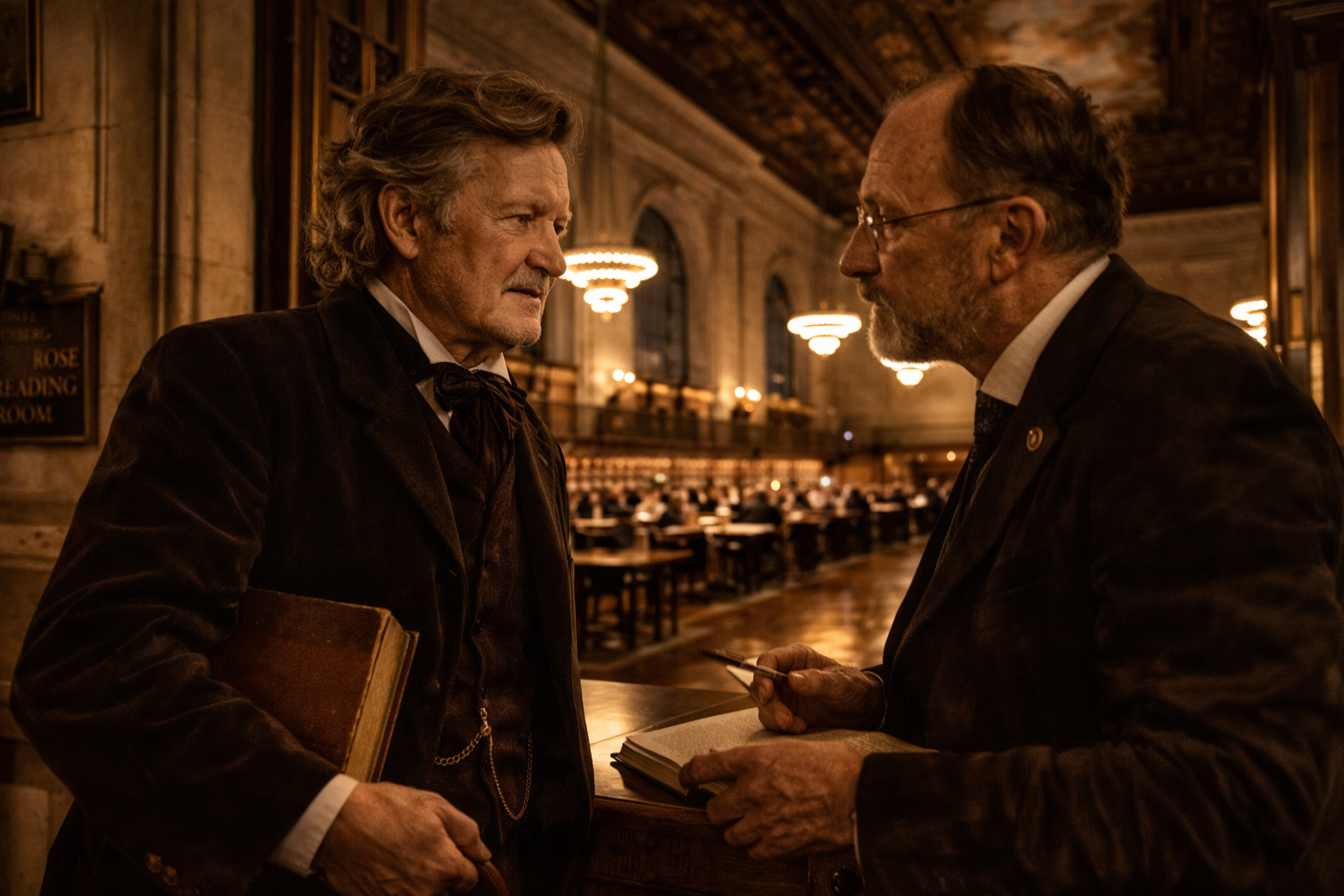
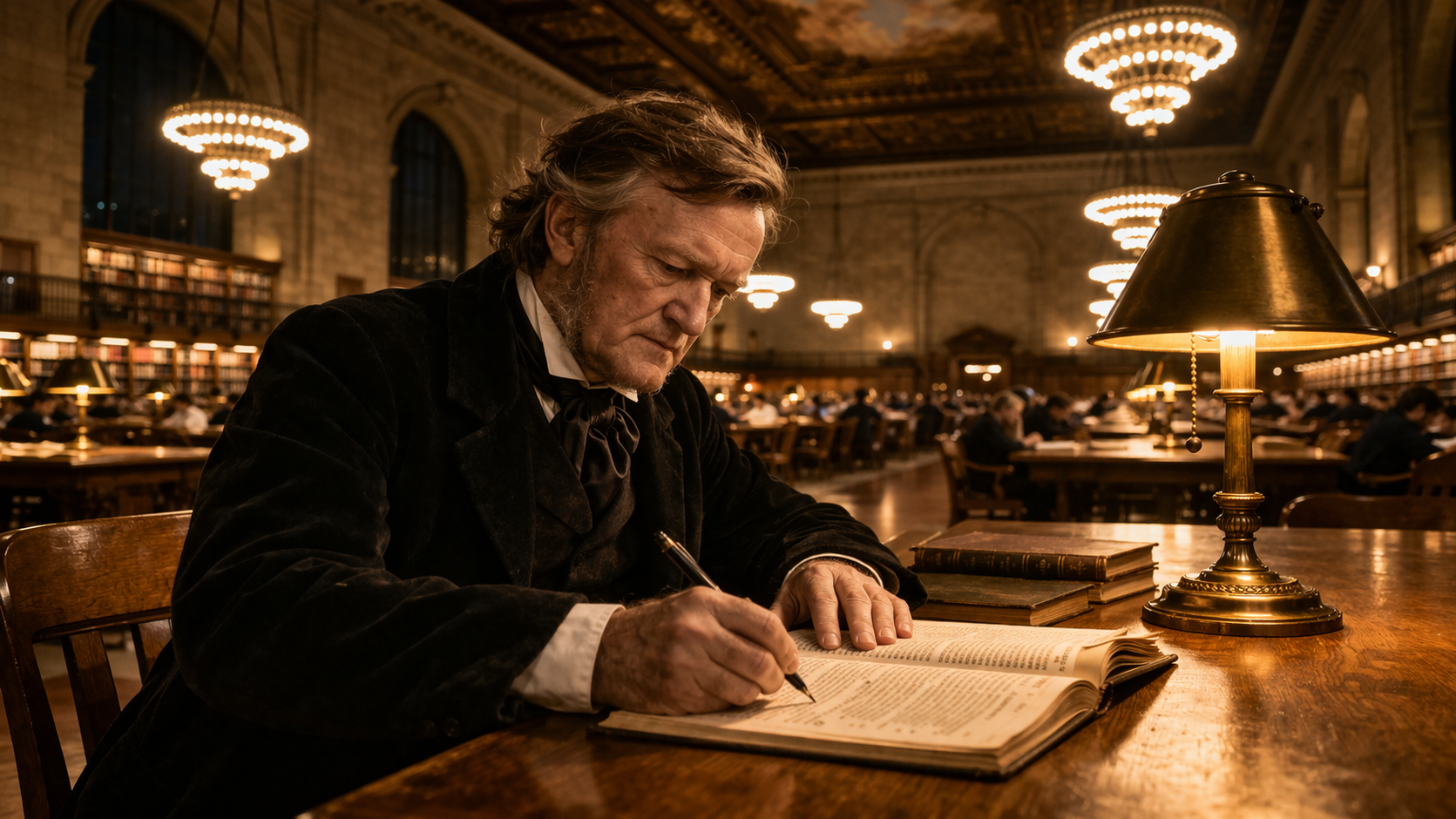
The Rose Main Reading Room makes Nacht available in daylight. All those readers bent over their books in concentrated silence, the high ceiling absorbing sound and time, the space functioning as a kind of civic Nacht. A shelter from the city's insistence on activity and resolution. The Cloisters, entered as afternoon fades, give you Nacht as architecture: stone enclosure, covered arcades, a space designed to hold the medieval world at arm's length from modernity, where time loosens and the Love Duet can do what it is designed to do. Unbuild the world around you, leave only the sound and the stone and the gradual recession of everything that Tag demands.
The mandatory silence node. Park bench, quiet block, back of a late train car, is Nacht without sound. This is the most demanding part of the walk, because it requires you to sustain the Romantic condition of Nacht without the music that has been creating it. Five minutes of sitting with unresolved desire, with the harmonics still resonating internally, with the darkness of wherever you've stopped. This is what Tristan is actually about. Not the beautiful sound of desire, but the condition of being in that desire without relief.
Die Nacht ist nicht das Ende des Tages. Sie ist der Ort, an dem der Tag aufhört zu lügen. Night is not the end of day. It is the place where day stops lying. This is what Wagner found in Novalis, in Schopenhauer, in the chord that refuses resolution for four and a half hours. Night is not absence. It is the presence of what day conceals.
Further Reading