Beyond Yourself and Nowhere Else: On Ekstase
das Wort / the word: die Ekstase (f.), pl. die Ekstasen
Aussprache / pronunciation: ek-STAH-zeh
Wortart / part of speech: Noun, feminine, borrowed from Greek via Latin
Register: Literary, religious, and psychological. Not an everyday conversational word but entirely familiar to educated German speakers. Carries the full weight of its classical origin. This is a word that knows exactly what it means and has always meant it.
Was das Wort wirklich bedeutet / What the word actually means
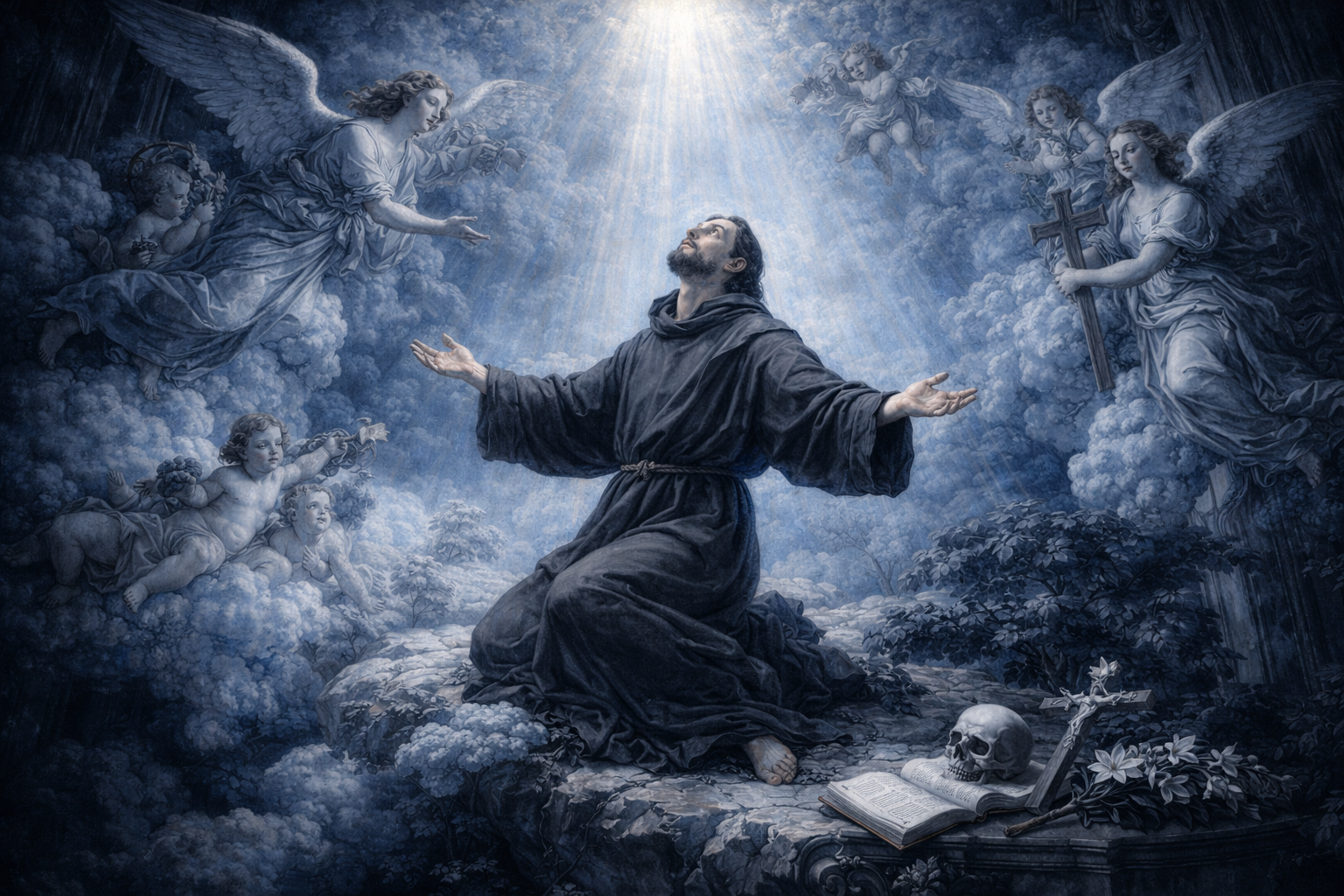
Ekstase is ecstasy, but not in the sense the word has acquired through overuse and dilution in contemporary English. It is not the mild pleasure of a good meal or a beautiful sunset. It is not even the intense pleasure of the erotic, though the erotic is among its possible occasions. Ekstase is a specific and radical condition. The state in which the self has left itself, in which ordinary consciousness has been displaced by an intensity of experience that the ego-structure cannot contain.
The Greek root makes this precise. Ek-stasis, from ek (out of) and stasis (standing, position), means literally to stand outside of oneself. To be in Ekstase is to have stepped outside of your ordinary standing, your normal positioned-ness in the world, your usual relationship to yourself. The self is still there, in some sense, you do not cease to exist during Ekstase, but you are no longer at yourself in the way ordinary consciousness maintains. You are displaced, ek-static, out-of-position.
This is precisely what the Love Duet enacts. As Tristan and Isolde move deeper into the night, their individual consciousness does not simply intensify. It displaces. The pronouns dissolve. Du becomes ich, ich becomes du, both become wir and then neither, the selfhood of each standing outside itself, no longer in its usual station. The duet is forty minutes of Ekstase, not of pleasure, but of self-displacement, the experience of being beside oneself in the most literal sense.
Understanding Ekstase properly means holding together three distinct traditions that have used the word. Religious mysticism, Romantic aesthetics, and clinical psychology. In Tristan und Isolde, all three are active simultaneously.
Die Etymologie: Griechisch ins Deutsche / Etymology: Greek into German
Ekstase entered German (and English) through Latin ecstasis, which was itself the Greek ékstasis minimally Latinized. The word belongs to the class of borrowings, many of them theological and philosophical, that German acquired through the Latin of the medieval Church and the Greek of classical scholarship, and which retain their foreign character in German in a way that the Latinate loan-words in English typically do not.
In German, Ekstase is immediately recognizable as a borrowing by its Greek structure. The initial Ek- (rather than the Germanic Aus-, which would be the native German equivalent of out of) and the -ase ending (from Greek stasis). A native German calque of Ekstase might be Selbstaustreten or Außersichsein (being outside oneself), and indeed außer sich sein (to be beside oneself) is the common German idiom for exactly this state: sie war ganz außer sich vor Freude, she was completely beside herself with joy. Außer sich before joy, grief, or rage. The same ek-static structure, mapped onto everyday German through the preposition außer (outside of, beyond).
The Greek stasis, standing, position, stability, appears in several German philosophical and political terms. Homeostase (homeostasis, the body's self-stabilizing), Katastase (an older term for settled condition), and in the Platonic vocabulary of das Ständige (the permanent, what stands). Ekstase is the opposite of stasis in this philosophical sense: where stasis is settled, stable, in-place, Ekstase is displaced, unstable, out-of-place.
Religiöse Ekstase / Religious Ecstasy
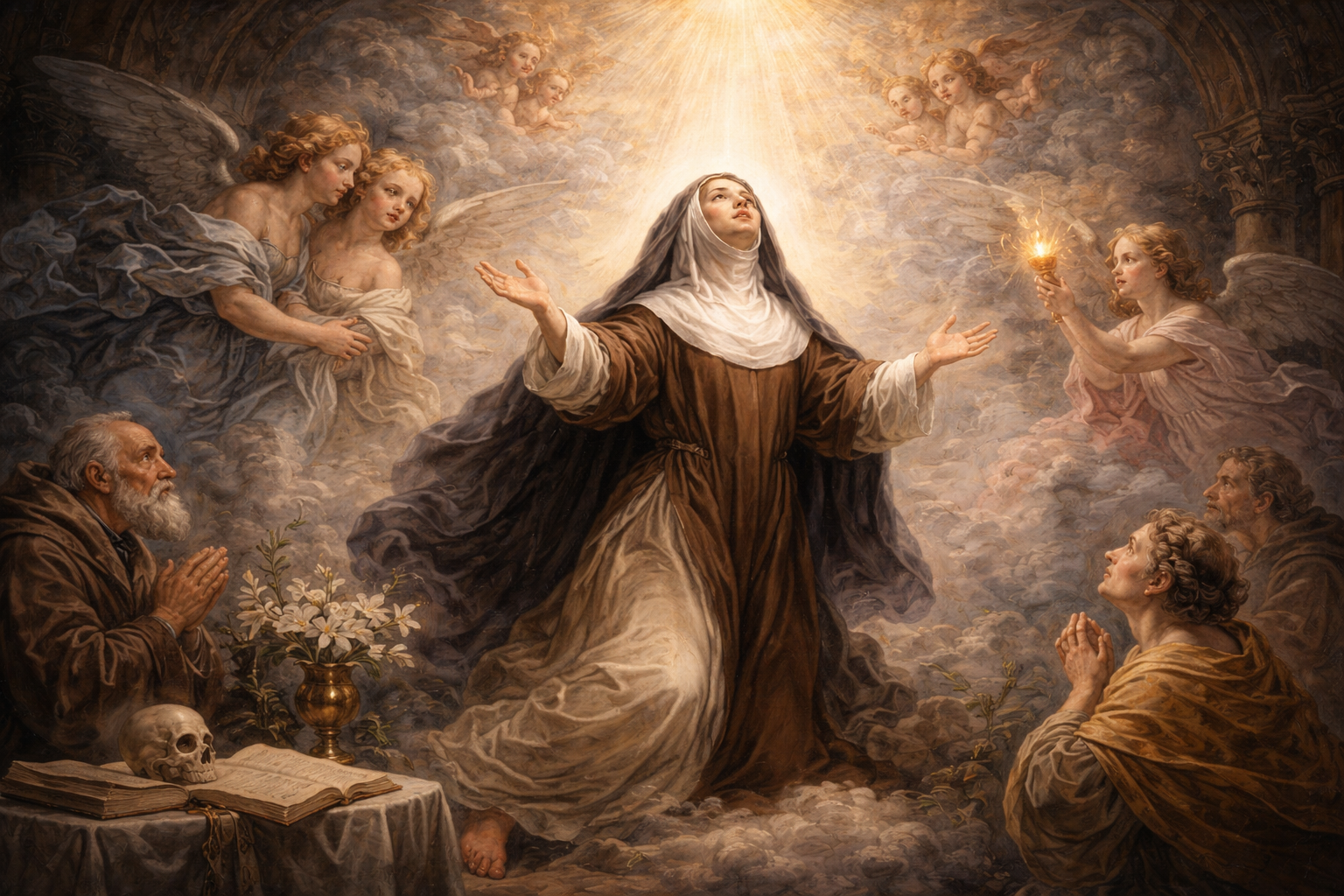
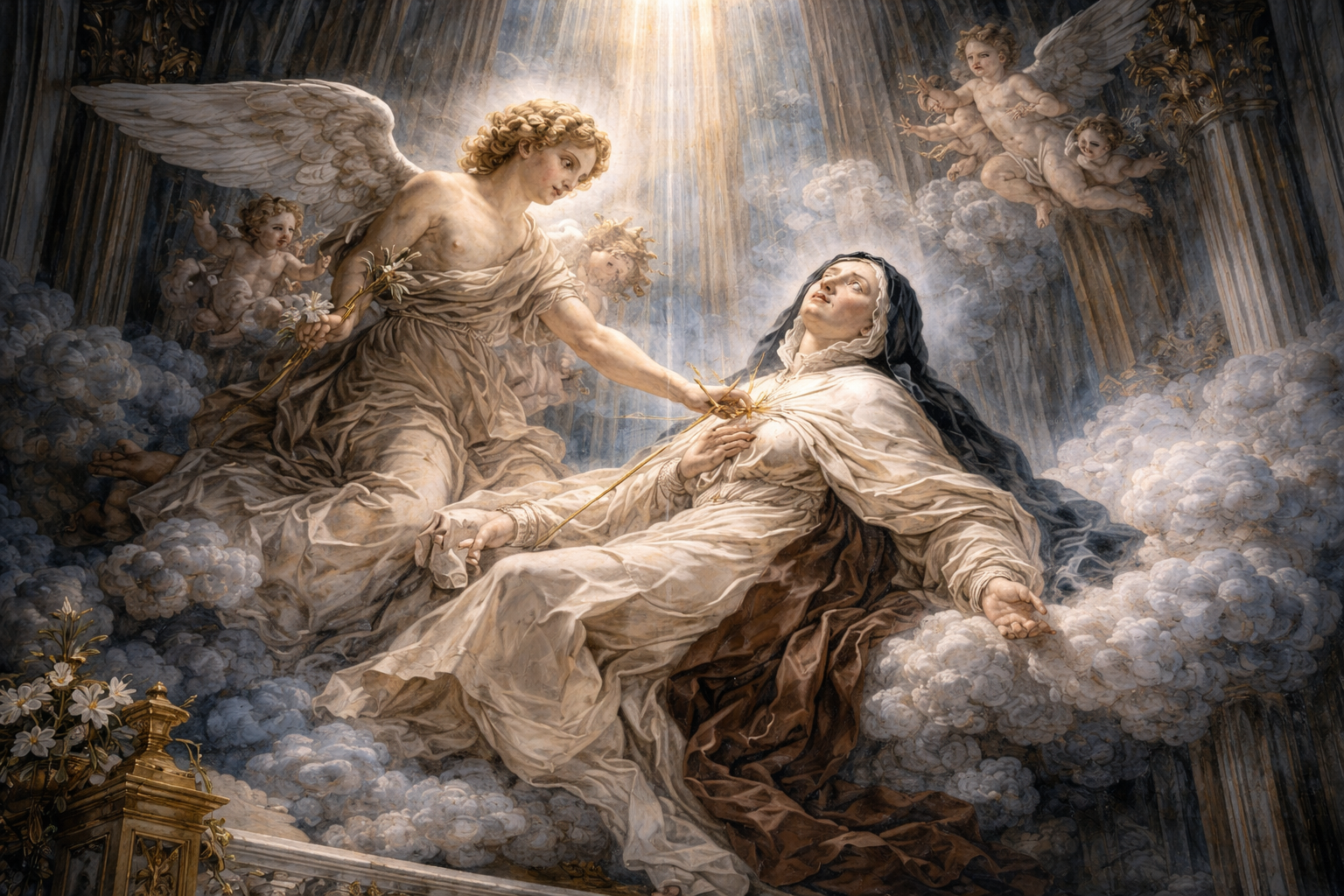
The history of Ekstase in Western culture is primarily a religious history. The great mystics of the Christian tradition, Meister Eckhart, Hildegard von Bingen, Teresa of Ávila, John of the Cross, described experiences of union with God in explicitly ekstatisch terms. The soul leaving its ordinary stance, its individual separateness, to be taken up into the divine. These experiences were authorized as genuine encounters with the holy, carefully distinguished from delusion and from diabolic mimicry, and integrated into the theological frameworks of the relevant traditions.
What mystical Ekstase and erotic Ekstase share, the reason the same word covers both, is the structure of self-displacement. In both, the individual ego-boundary becomes permeable. In both, something beyond the individual self is encountered as more real, more present, more urgent than the self's ordinary contents. In both, the return to ordinary consciousness is experienced as a kind of diminishment. A descent from a higher state into the merely personal.
Meister Eckhart, the 13th-century German Dominican mystic and one of the most philosophically sophisticated thinkers the German language has produced, described the soul's relationship to God in terms that anticipate Schopenhauer and Wagner almost directly. The soul must relassen (release, let go) its individual will, its Eigenheit (ownness, selfhood), to encounter God. The divine encounter is precisely the moment of Auflösung des Selbst, the dissolution of individual identity into the Absolute. Eckhart's vocabulary of divine union and Wagner's vocabulary of erotic union are, at the structural level, the same.
This is not coincidence. Wagner had read the German mystics, directly and through secondary sources. The Love Duet's theology of night and union is explicitly mystical in its structure, whatever the overt subject matter. Ekstase in Tristan is not secular. It is Romantic mysticism with its theological content redistributed from God to love.
Romantische Ästhetik und Ekstase / Romantic Aesthetics and Ecstasy
For the German Romantics, Ekstase was an aesthetic category as much as a religious one. The experience of great art was supposed to be ekstatisch. It should displace the self from its ordinary standing, produce an intensity of experience that the ego could not comfortably contain, create the conditions for genuine self-transcendence.
Friedrich Schlegel's concept of Begeisterung (enthusiasm, literally en-spiriting, being filled with spirit) overlaps with Ekstase but is somewhat more controlled: Begeisterung is the creative artist's heightened state, the condition in which inspiration descends. Ekstase is the audience's analogue. The state produced in the listener or reader by genuine contact with the work.
This is the aesthetic theory implicit in the April walk's instruction to listen to the Love Duet seated in the Cloisters for thirty to forty minutes without interruption. The instruction is not simply about duration. It is about allowing enough time for Ekstase to occur, if it is going to. Ekstase cannot be forced. It can only be waited for. The conditions that make it possible are created through preparation. The right space, the right music at the right volume, the right quality of sustained attention. Whether the self then actually steps outside itself, whether Ekstase actually occurs, cannot be guaranteed. But the conditions can be arranged.
Wagner was the supreme arranger of these conditions. The Love Duet is forty minutes long not because the musical material requires that length but because Ekstase requires preparation. The self must be gradually loosened from its ordinary anchors, its practical concerns, its habitual distractions, its management of the social world, before it can be displaced. The forty minutes are the time required for ordinary consciousness to relax sufficiently that something beyond it becomes accessible.
Klinische und Psychologische Ekstasen / Clinical and Psychological Ecstasies
In contemporary psychology and psychiatry, ekstatisch states are recognized as genuine experiences but treated with considerable clinical caution. Epileptic auras can include brief experiences of Ekstase. Dostoevsky famously described this in his characters (he suffered from epilepsy himself) as a moment of extraordinary clarity and bliss immediately preceding a seizure. Psychotic states can include grandiose experiences of self-dissolution and cosmic union that have the structure of Ekstase but without the voluntary or aesthetically-produced quality. Drug-induced states, particularly those produced by substances like MDMA, whose street name references the Greek directly, are ekstatisch in structure.
What these clinical instances share with the mystical and the aesthetic is the same ek-static structure. Ordinary ego-consciousness displaced, boundaries between self and world becoming permeable, an intensity of experience that the cognitive apparatus cannot smoothly process. What distinguishes the mystical and aesthetic instances from the clinical ones, in the Romantic account, at least, is the quality and source of the dissolution. Religious and aesthetic Ekstase dissolves into something higher. Clinical Ekstase dissolves into something undifferentiated, pathological, or chemically induced.
Wagner was aware of this distinction. The Love Duet is not chaotic or formless. It is one of the most rigorously constructed forty-minute spans of music in the repertoire. The Ekstase it produces is organized, purposeful, directional. It leads somewhere specific. Toward the dissolution of daylight selfhood into a union that, in the opera's logic, can only be consummated in death. This is Ekstase as a destination, not as a symptom.
Grammatik und Gebrauch / Grammar and Usage
Die Ekstase is feminine. It declines regularly.
The adjective: ekstatisch, ecstatic, in a state of ecstasy. Ein ekstatisches Erlebnis, an ecstatic experience. Ekstatischer Jubel, ecstatic rejoicing. The adjective is fully active in contemporary German across religious, aesthetic, and colloquial registers.
Common constructions:
in Ekstase geraten, to fall into ecstasy, to enter a state of ecstasy
in Ekstase versetzen, to send into ecstasy, to induce ecstatic states in someone (as music or a demagogue might)
außer sich sein, to be beside oneself (the everyday German idiom for the ekstatisch state, using native German preposition rather than Greek root)
von sich selbst entrückt, transported beyond oneself (entrückt — translated, carried away, rapt — is a particularly beautiful word for the ekstatisch state: you have been removed from your ordinary location)
The related verb: entzücken, to delight, to charm, to enrapture. Entzückt (enchanted, delighted) shares the rücken (to move, to shift) root with entrückt and encodes the same ek-static movement. The self shifted from its usual position by the force of delight.
Verwandte Wörter / Related Words
ekstatisch (adj.), ecstatic
außer sich, beside oneself (the everyday equivalent)
entrückt (adj.), rapt, transported, carried away (a beautiful near-synonym for the ekstatisch state)
die Begeisterung, enthusiasm, inspiration (more controlled than Ekstase, the artist's heightened state)
die Verzückung, rapture, transport (literary and slightly archaic, close to entrückt)
die Trance, trance (borrowed, a related altered state, less intense than Ekstase)
die Raserei, frenzy, madness (a darker form of the ekstatisch, self-displacement as violence rather than union)
die Auflösung, dissolution (April's companion, Ekstase leads to Auflösung)
die Nacht, night (April's first word, Nacht is the condition that enables Ekstase)
der Tod, death (April's fifth word, the limit-case of Ekstase, the dissolution that does not reverse)
Die Verbindung zum Weg / Connection to the Walk
The walk offers Ekstase three times, in three different modes, at three sites. At the Rose Main Reading Room, the Prelude creates the conditions for a mild Ekstase of attention. The sustained refusal to act, to resolve, to do. The holding of unresolved desire in awareness for twenty minutes without outlet, begins the loosening of ordinary ego-anchors. This is Ekstase in its preparatory phase. Not the self-displacement itself but the deliberate relaxation of the self's habitual grip.
At the Cloisters, the Love Duet carries this further into actual Ekstase if the conditions are right. Thirty to forty minutes of sustained listening in stone enclosure, the medieval withdrawal from historical time, the music systematically dismantling the structures of daylight selfhood. This is where Ekstase becomes available as a genuine experience rather than a conceptual description. The walk's prompt, are you waiting for it to end, or resisting its ending? identifies the moment when Ekstase has occurred. The moment when you no longer want the music to stop, when you have moved from the self that experiences music to the self that has become continuous with it.
The Liebestod, heard finally in exhaustion, is Ekstase completing itself as Auflösung. The self has spent the evening being gradually loosened from its ordinary anchors. The Liebestod removes the last of them. The instruction to hear it as exhaustion rather than transcendence is precisely right. Genuine Ekstase at this scale is not an elevation but a depletion. The self that enters the Liebestod is already so far outside its ordinary stance that what sounds like triumph is really the last reserves giving way. Ekstase ist nicht das Ende des Selbst. Sie ist das Selbst, das seine Grenzen vergisst. Ecstasy is not the end of the self. It is the self forgetting its boundaries.
Further Reading