Oriented, Not Optimistic: Prospection Through Wagner Is Not Hope
Martin Seligman spent the first half of his career studying learned helplessness. He discovered that animals subjected to inescapable punishment eventually stop trying to escape even when escape becomes possible. They learn that the future will be like the past, and they stop moving toward it. The discovery illuminated something fundamental about depression. It is not primarily a disorder of memory or feeling but of prospection. The depressed animal has stopped generating internal representations of possible futures and choosing among them. It has, in a precise psychological sense, stopped walking.
The second half of Seligman's career reversed the question. If the essential damage in learned helplessness is the loss of forward orientation, then the essential capacity in flourishing is its presence. He called this prospection. The ongoing human activity of simulating possible futures, evaluating them against each other, and orienting behavior toward the ones that seem worth reaching. His 2016 book with Railton, Baumeister, and Sripada, Homo Prospectus, makes the argument directly. The basic premise that humans are driven by the past is wrong, or at least insufficient. We are not billiard balls whose trajectory is determined by what has already struck us. We are organisms that are continuously, and in most of our waking moments, navigating toward things that have not yet happened. This reframing has implications that extend well beyond clinical psychology, and several of them lead directly to the scored walk.
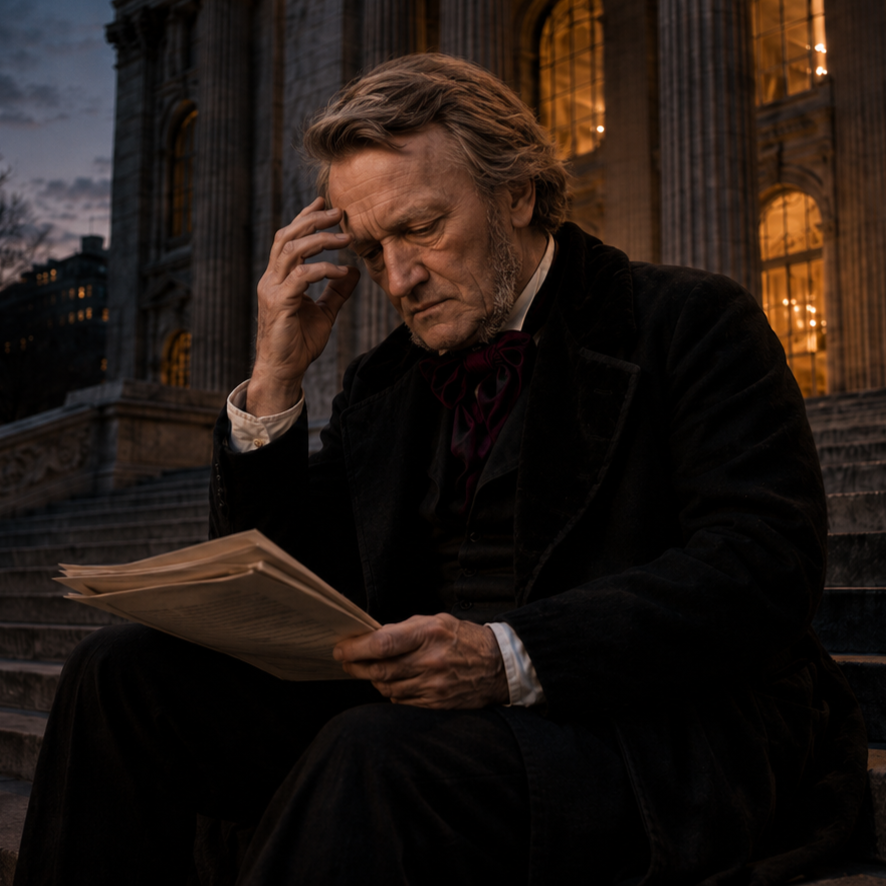
Wagner completed the libretto for the Ring cycle in 1852, while in exile in Zurich. He had no orchestra. He had no singers capable of the roles he was writing. He had no theatre in which to stage what he was imagining. He had, in the most literal sense, no audience. The people who would eventually hear the Ring at Bayreuth in 1876 were children in 1852, many of them not yet born. The work he was doing bore no rational relationship to anything that existed around him. It was prospection operating at maximum intensity under maximum adversity.

This is not a romantic way of describing creative genius. It is a description of a specific psychological capacity. The ability to generate a detailed and fully realized internal representation of a future state and to organize present behavior around it, even when present conditions offer no evidence that the future state is reachable. Seligman would recognize it immediately. The Ring libretto in Zurich is what pragmatic prospection looks like when it is functioning at its most extreme. Wagner was simulating a future event, a performance, an audience, an experience of the work, so completely that he could write the whole text of it in the complete absence of any means of realization.
The exile years were also, by every account, among the most productive of Wagner's life. This is not a coincidence. Depression contracts prospection. Flourishing expands it. The man in the Zurich apartment writing the Ring in the wrong decade was prospecting continuously and productively, and the work was the record of that prospection. This is the detail from the neuroscience that changes how the scored walk looks.
The hippocampus is the brain structure most associated with spatial navigation, the cognitive system that tracks where you are, where you have been, and where you are going. It contains place cells, neurons that fire specifically when you occupy particular locations in space. For decades, this was understood as a memory system: the hippocampus records where you have been.

Then researchers discovered something stranger. The same place cells fire when you are not in the space at all. They fire during rest, during sleep, and during the simulation of future routes through familiar environments. The hippocampus is not only a record of past navigation. It is a simulation engine for future navigation. The neural machinery you use to walk through a city is continuous with the neural machinery you use to imagine walking through a city tomorrow. Spatial navigation and episodic prospection share the same neural substrate.
The scored walk is, in this light, not metaphorically related to prospection. It is the same act. Every step through a known neighborhood activates the same systems as every internal representation of where you might go next. The walk is thinking about the future. The thinking about the future is, at the level of hippocampal firing, a walk.
This explains something the project has noticed without being able to name. The walks produce a particular quality of mental clarity that is not the same as the clarity of sitting with headphones at a desk. It is not only that the body moves or that the city provides friction. It is that the act of navigating space, of orienting the body toward a sequence of future positions, activates prospective cognition in its most elemental form. The music arrives into a brain that is already, because it is walking, oriented toward what has not yet happened. The scored walk is structured prospectively at every scale.

At the scale of the individual walk, the instructions give you a sequence of future locations before you arrive at them. You read them in advance. You build an internal model of the walk before you take it. The walk, when you take it, is a comparison between the simulation you built and the city you find. The gap between the two. The rain that was not predicted, the construction that has closed a street, the unexpected quality of light at 4pm in February, is where the most alert attention lives. You are prospecting the walk as you walk it.
At the scale of the month, each walk is preparation for the next. The January harbor walk builds an internal model of what Wagner sounds like in cold, open air, against water. The February Tannhäuser walk on the Bowery builds a model of what Wagner sounds like on a commercial street, through crowds, against the specific friction of a city that does not pause for the music. These models accumulate. By March, the ear is different from what it was in January. By April, when the Tristan walk begins, it will carry everything the preceding walks have deposited.
At the scale of the year, the whole structure is prospective. Twelve operas, twelve months, twelve walks, moving through an ordered sequence toward December and Das Liebesverbot. The end is known in advance. The path to it is not. Every month is a simulation of the remaining months, updated by the evidence of the walk just completed.

Seligman's research on pragmatic prospection found that it correlates positively with life satisfaction and negatively with anxiety and depression, and that it tracks with other adaptive personality traits associated with achievement and psychological adjustment. The scored walk is not a therapeutic intervention. But it structures time and attention in exactly the ways that pragmatic prospection research describes as conducive to flourishing: clear future orientation, specific goals, flexible execution, continuous updating of the model against the evidence.
Wagner in Zurich was not optimistic. The historical record is clear on this. He was in debt, in exile, in a marriage that was failing, in love with someone else's wife, physically unwell, frequently convinced that the Ring would never be performed in his lifetime. His letters from the period are not the letters of a man with a positive outlook.
But he continued to work. He built internal representations of a future performance of an opera that had no means of being performed, in a theatre that did not exist, for an audience that had not yet been assembled, and he organized his daily life around those representations with complete consistency. This is not optimism. Optimism is a disposition toward the future. What Wagner was doing in Zurich is something more structural: the maintenance of forward orientation in the complete absence of grounds for optimism. The practice continued because stopping was not something he entertained, and because the practice was itself the evidence that the future remained open.
This distinction matters for the scored walk. The project is not optimistic in the sense of expecting particular outcomes. It does not know what December will produce or what the Tristan walk will feel like or whether nine more months of this practice will change anything in any way that can be measured. What it has is forward orientation. The walks are scheduled. The operas are assigned to months. The German words accumulate, one by one, in the early mornings. The project continues not because it knows where it is going but because continuing is the act that keeps the destination possible.
Seligman would say this is exactly the mechanism. The organism that keeps prospecting, even without grounds for particular outcomes, is the organism that keeps its futures open. The one that stops prospecting, that learns, as his early animals learned, that the future will simply replicate the past, has closed them.
There is a German word for what Wagner was doing in Zurich. Vorfreude. It is usually translated as anticipation, but that translation misses the affective specificity. Vor means before. Freude means joy. Vorfreude is the joy that exists before the thing it is the joy of. The pleasure of the anticipated experience, not the experience itself. The concert not yet begun. The walk not yet taken. The opera not yet performed.
Wagner did not have Vorfreude in Zurich. He had something harder and less comfortable. The act of oriented continuation in the absence of joy. The Ring was not pleasurable to write during the exile years. It was necessary to write. The distinction is significant.
The scored walk is closer to Vorfreude. Each walk anticipates the next. The Tristan walk, which is coming in April, already exists as an internal model, a simulation built from everything the preceding walks have deposited. That simulation is not yet the walk. But it is already, in Seligman's terms, operating. It is already organizing attention and behavior and the Tuesday mornings spent with German grammar. It is already producing, in the specific technical sense that prospection research describes, a contribution to the kind of forward orientation associated with wellbeing and flourishing.
The animal that walks toward what has not happened yet. This is what Seligman calls the defining feature of human cognition, the capacity that distinguishes the flourishing organism from the one that has learned helplessness. It is also, in the most precise neurological sense available, what a scored walk is. The hippocampus fires in the same pattern whether you are walking through a city or imagining tomorrow's walk. The place cells do not distinguish between navigation and prospection. They are the same act, running in the same architecture, pointing in the same direction. Forward.