A City You Can Only Learn by Leaving
Note: Some articles belong to one site. These belong to all of them. Superconnectors are pieces written at the intersections. Where opera meets product thinking, where walking meets AI, where the archive meets the self.
Every walker has a first city. Mine was not New York. I grew up in England, in a landscape of post-industrial flatness and long flat horizons and skies that went on longer than seemed necessary. It was a beautiful place by any conventional sense. But it was the place that taught me what a place was. The specific weight of familiar streets. The way a route walked a thousand times becomes something between memory and body. The knowledge that accumulates in the feet before it reaches the head. I left it twenty years ago and have not lived there since.
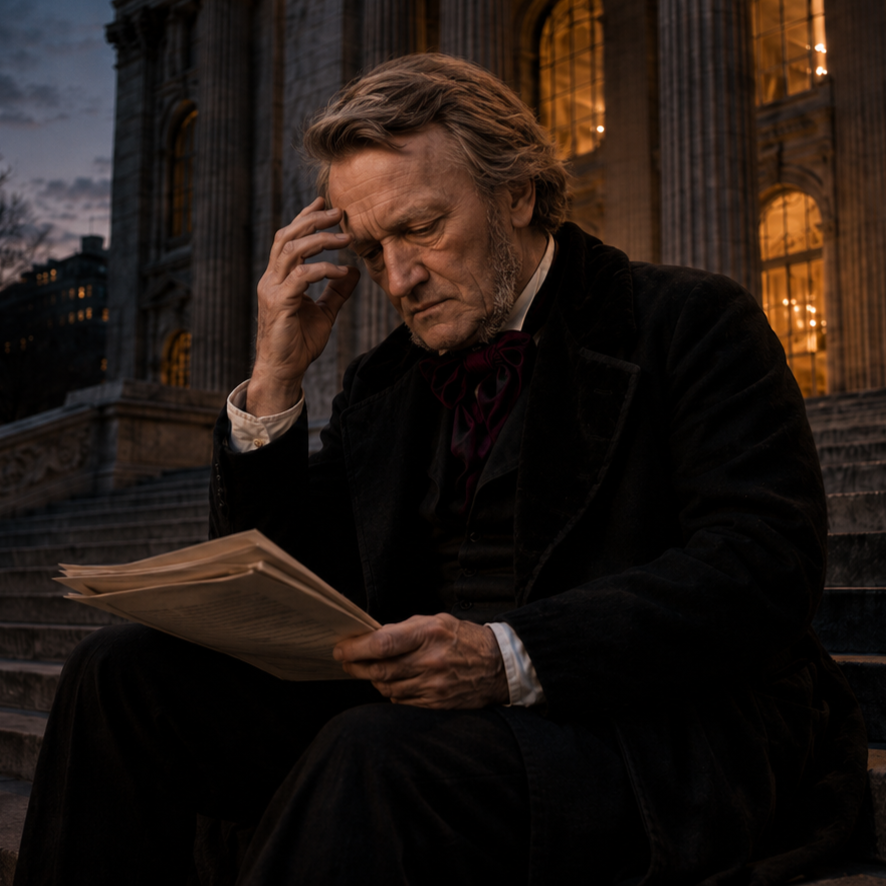
New York teaches you things which can only be learned in New York. The grammar of the grid. The way altitude changes the texture of the street. The specific Manhattan light in October that falls at an angle found nowhere else. The city as a text readable on foot, its history pressed into the pavement, its present visible in the windows above the storefronts.
I learned this slowly and then completely. The immigrant's education in a chosen city is one of the most intense forms of attention available. You have no unconscious knowledge to fall back on. Every street is a problem to be solved. Every system, subway, neighborhood, social register, requires conscious decoding. The city that is home to everyone around you is, for you, a continuous act of translation. And then, at some point, it becomes home. The decoding becomes fluent. The streets become unconscious. The city stops being a text and becomes the medium through which you move without thinking.
The Aufbruchmatt practice is built on the principle that music can restore consciousness to a city that has become invisible through familiarity. Wagner scored to a commute makes the commute audible again. The opera and the street read each other. The walk becomes something other than transit. I have scored walks through New York in all twelve months. I have scored walks through Philadelphia and Athens and Princeton and Paris and Vienna and Berlin. I have not scored a walk through the place I'm from. Partly this is practical. I don't walk there regularly. But the deeper reason is something more like avoidance. The place I'm from is the place I learned walking before I knew I was learning it. It doesn't need a score to be present. It's already inside the walk.
There is a route I walked every day for five years in my early twenties, from a terraced house on a street I no longer remember the name of, to a job in a town centre that has since been substantially demolished and rebuilt. I could not walk it now because significant portions of it no longer exist in the form I remember. But I can still walk it in the body. The slight uphill gradient at a particular junction. The underpass that smelled of concrete and something chemical. The turn that added four minutes but avoided a street I found unpleasant for reasons I never examined.
This route is not in any archive. It was never written down. It exists only in the accumulated procedural memory of a body that walked it a thousand times and then stopped. The New York walking practice is, in part, an attempt to create something that my English childhood never produced. A documented, scored, articulate account of what it means to pay attention to a place. To leave something behind that says: I was here. I walked this. It meant something.
What I understand now, having spent years thinking about how cities are learned and what walking does to attention, is that every walk I take in New York is in conversation with those earlier walks in a place that did not know it was teaching me anything. The slopes of the Somerset countryside are why I walk to find elevation. The post-industrial grey of Englishness is why I register the particular quality of Manhattan light. The leaving is why I understand the immigrant's relationship to a city as a form of love that can't quite be returned in kind. You can only learn what a city means by living somewhere else long enough to see it clearly. The first city shapes everything and reveals nothing until the distance is sufficient. Twenty years, it turns out, is sufficient.