Aufbruch as Apologia: Wagner, Self-Explanation, and the Ethics of Making Work Legible While It Is Still Becoming
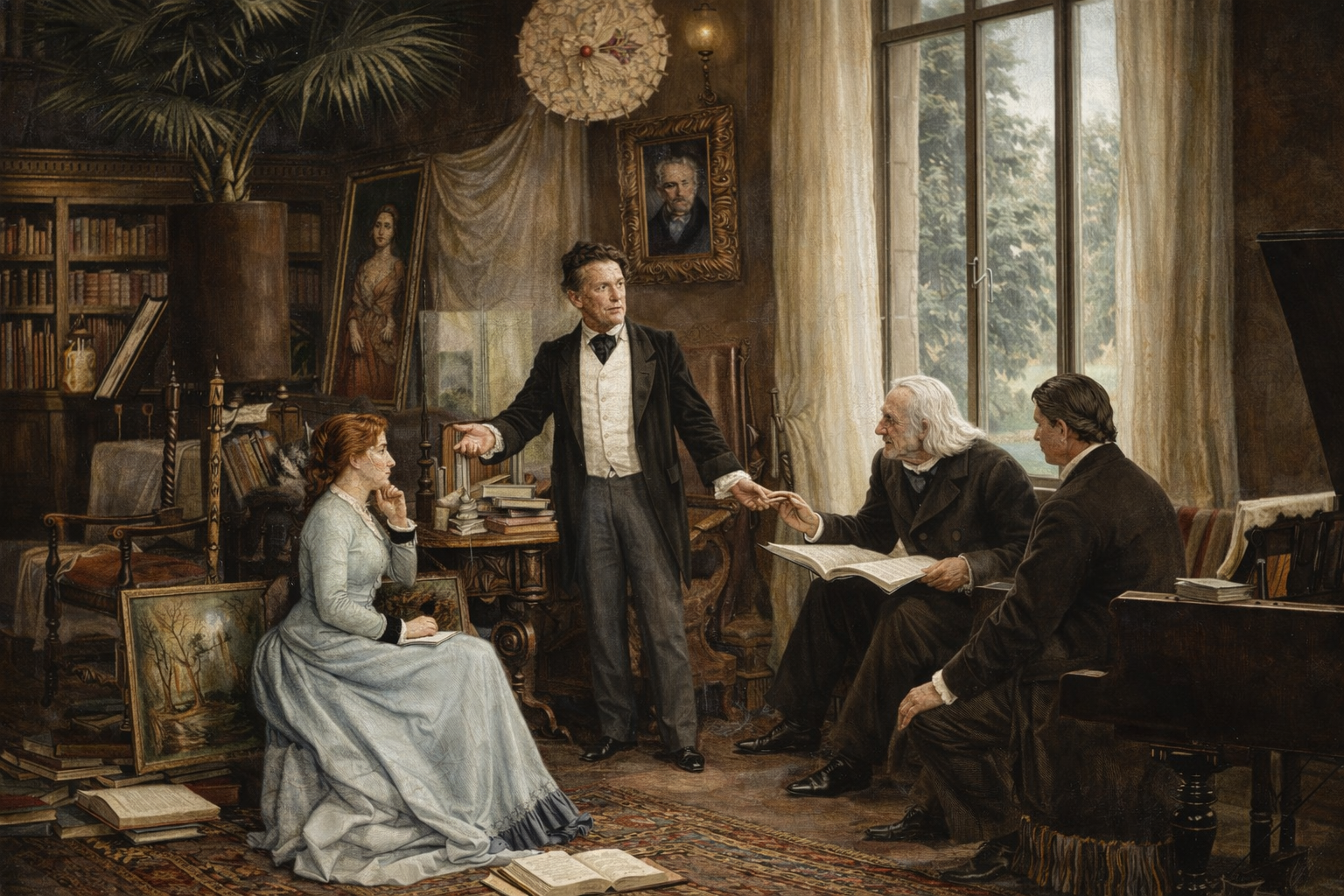
In the middle of the nineteenth century, exiled, indebted, and artistically unfinished, Wagner made a curious decision. Rather than retreat into silence while his grandest works remained unrealized, he published an extended prose document explaining himself. A Communication to My Friends was not a manifesto in the conventional sense, nor was it autobiography as confession. It was something stranger and more revealing. An attempt to make an unfinished artistic life legible in real time.
This gesture, explaining the work before the work could fully exist, runs counter to a deeply ingrained modern instinct. We are accustomed to treating interpretation as retrospective, to believe that explanation contaminates creation, that art should arrive complete, sealed, and only then be framed. Wagner rejected this logic outright. He understood that the scale and ambition of what he was attempting, nothing less than a reconfiguration of opera’s relationship to myth, music, drama, and social life, required a parallel act of narration. The work could not be received without a map.
Communication therefore performs a subtle ethical maneuver. Wagner does not merely defend past failures or justify future aspirations. He asks his audience to accompany him through a process of becoming. Earlier operas are neither disowned nor celebrated. They are positioned as necessary stages in a long intellectual and emotional apprenticeship. The text insists that coherence emerges over time, and that judgment without context is a category error. To read Wagner properly, one must read him longitudinally.

This is where Aufbruch/Matt quietly, perhaps unintentionally, aligns itself with a deeply Wagnerian logic. It presents as a project of movement. Walking circuits, urban itineraries, seasonal rhythms, music encountered in motion rather than in seats. Yet beneath the choreography lies something more structural. Like Communication, the project does not simply present artifacts. It explains itself as it unfolds. Orientation pages, bridging paragraphs, methodological notes, and reflective codas do not sit outside the work. They are the work’s conditions of intelligibility.
This matters because Aufbruch/Matt resists a stable genre. It is not travel writing, not music criticism, not wellness practice, not diary. Yet it borrows from all of these. Wagner faced a similar problem. His mature music dramas did not fit inherited categories, and he understood that novelty without guidance reads as failure rather than innovation. Communication is therefore not apologetic in the colloquial sense. It is infrastructural. It builds interpretive capacity in advance.
What Wagner intuited, and what Aufbruch/Matt reenacts in a contemporary register, is that certain forms cannot be evaluated piecemeal. They demand duration. They demand patience. They demand an audience willing to suspend premature judgment in favor of cumulative meaning. The act of explanation is not a concession to weakness. It is a demand for fair terms of engagement.
There is also a temporal argument embedded here. Wagner’s text repeatedly emphasizes that his ideas only become visible across time. That motifs, ethical positions, and dramatic strategies reveal themselves retroactively. This is not unlike Aufbruch/Matt’s insistence on months rather than moments. A single walk, like a single opera, is incomplete by design. Meaning accrues through recurrence, variation, and return.
Seen this way, the project’s scaffolding, the why this month, the why this route, the seasonal framing, is not indulgent. It is pedagogical. It trains perception. Wagner did not assume his audience knew how to listen to what he was composing; Aufbruch/Matt does not assume its readers know how to inhabit Wagner in the modern city. In both cases, explanation is an act of care.
There is a further, more uncomfortable parallel. Communication is written from a position of vulnerability. Wagner is materially insecure, politically displaced, and professionally stalled. The text exists because the operas it anticipates cannot yet. Aufbruch/Matt, too, emerges from a moment of fracture. From a dissatisfaction with contemporary attention economies, from the erosion of deep listening, from the bodily constraints that sometimes interrupt the project’s literal walking. In both cases, explanation fills a gap left by interruption.
Crucially, Wagner does not present interruption as failure. He reframes it as generative delay. The prose becomes a holding pattern for thought, a space where the future work can be rehearsed conceptually before it arrives musically. Aufbruch/Matt performs a similar maneuver when reflection, stillness, or altered movement replaces physical traversal. The project does not halt. It rearticulates itself.
This is perhaps the most Wagnerian aspect of all. The refusal to separate method from meaning. Wagner’s prose is not ancillary to his operas; it encodes the same worldview through a different medium. Aufbruch/Matt’s meta-writing, its self-situating voice, its persistence in explaining its own logic, does the same. The work argues for itself not through assertion, but through demonstrated coherence over time.
There is, finally, an ethical dimension to this alignment. Wagner’s Communication asks his audience for something rare, trust. Trust that unfinished work deserves attention. Trust that explanation is not manipulation but orientation. Trust that coherence may arrive later than comfort. Aufbruch/Matt makes a similar request of its readers. It does not promise immediate payoff. It promises a way of seeing that clarifies only through sustained participation.
In an age which fetishizes immediacy and treats context as optional, this stance is quietly radical. To explain oneself while still becoming is to resist the demand for premature closure. Wagner understood this necessity when the scale of his ambition exceeded the patience of his time. Aufbruch/Matt inherits that insight not as homage, but as method. It is not building a monument. It is writing its own Communication. Month by month, step by step. So that when the work is finally seen whole, it will already have taught its audience how to read it.
Further Reading