From Twin Suns to Valhalla: Star Wars as Wagnerian Apprenticeship

The claim that Star Wars is influenced by Wagner is true in the narrowest, least interesting sense. Yes, the use of recurring themes recalls leitmotivic practice. Yes, the mythic scaffolding of heroes, falls, redemptions, and cyclical time invite comparison. But influence, framed this way, remains superficial. It treats Wagner as a library from which motifs are borrowed, rather than as a listening discipline to be learned. What Star Wars actually does is far more consequential. It conditions its audience into Wagnerian listeners. It does not merely echo Wagner’s techniques. It trains modern ears to tolerate, understand, and eventually desire the kind of musical thinking Wagner demands.
This distinction matters, because Wagner’s real difficulty has never been musical complexity alone. It is perceptual. Wagner asks his audience to listen structurally rather than episodically, to experience music not as ornament or interruption but as narrative logic itself. His operas refuse the division between moment and meaning. Nothing is self-contained. Everything refers backward and forward simultaneously. To listen to Wagner is to submit to a system in which memory becomes an active musical faculty. Most modern audiences are not born with this capacity. They must acquire it. Star Wars functions, deliberately or not, as that acquisition process.
The modern listener arrives in Wagner’s world poorly prepared. Popular music privileges immediacy. Film music, historically, trained audiences to feel rather than to track. Themes existed to underline emotion, not to accumulate philosophical weight. Wagner explodes this model. In his work, music does not support drama. It is drama. Unfolding across hours through transformation rather than repetition. The orchestra thinks. The listener must learn how to think with it.
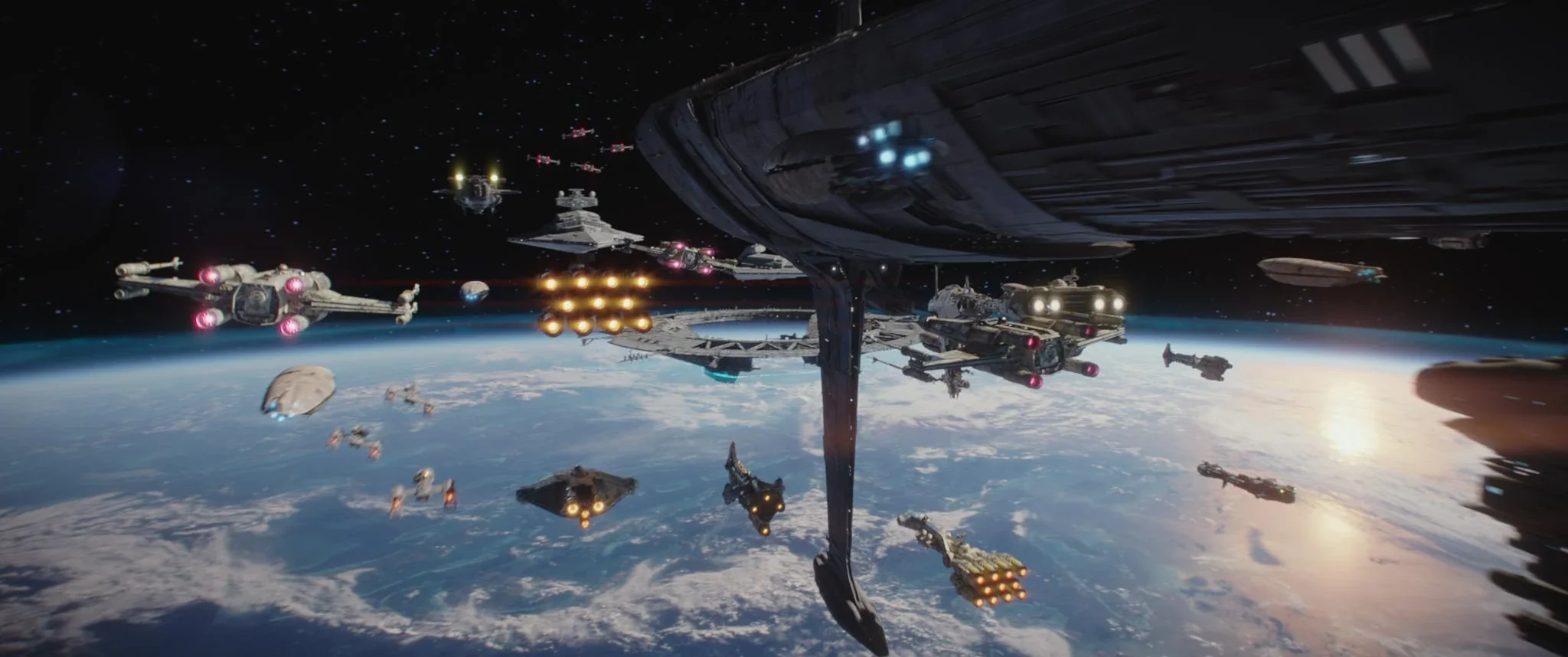
Star Wars quietly solves this problem by embedding Wagnerian musical cognition inside a medium audiences already trust, narrative cinema. It does not ask viewers to adopt a new listening posture explicitly. Instead, it rewards them for doing so. Across its films, music ceases to function as background affect and begins to operate as narrative evidence. Themes return not as nostalgic callbacks but as moral verdicts. A harmonic shift tells you something before the screenplay does. Music becomes a parallel intelligence, often a more reliable one than dialogue. Star Wars habituates audiences to the idea that music carries causal narrative force.
Once that habit is established, Wagner’s demands no longer feel alien. The listener has already been trained to treat sound as a system of consequences rather than sensations. Crucially, this training happens over time. Not just within a single film, but across decades of cultural repetition. Star Wars is not merely consumed. It is lived with. Its themes are heard at different ages, under different emotional conditions, accruing personal memory alongside narrative memory. This mirrors Wagner’s own long-range musical logic. Wagner composes not for instant recognition, but for delayed resonance. Meaning ripens slowly. What was once heroic becomes tragic. What was once seductive becomes poisonous. Star Wars teaches audiences to accept this temporal elasticity of meaning.
This is why leitmotif, taken alone, is an insufficient explanation. Leitmotifs are not the lesson. Temporal listening is. Star Wars conditions audiences to track continuity across fragmentation. To remember through cuts, sequels, and generational gaps. Wagner asks for the same skill, only without cinematic shortcuts. The Star Wars listener arrives pre-trained.

Star Wars additionally normalizes musical seriousness as a primary storytelling mode in a culture otherwise suspicious of it. Wagner’s operas make no apology for their scale. They assume that metaphysics belongs in music. Modern audiences, however, have been trained to distrust earnest myth, associating it with either childish fantasy or ideological danger. Star Wars reintroduces mythic seriousness under the cover of popular entertainment. It teaches audiences that it is acceptable, even pleasurable, to experience moral argument through sound.
This matters enormously for Wagner reception. Wagner’s music dramas demand not irony but surrender. They require listeners willing to engage with grand symbolic architectures without distancing themselves emotionally. Star Wars creates precisely that willingness. It makes the orchestra safe again. Not as nostalgia, but as infrastructure. The orchestra becomes a vehicle for destiny, not decoration.
Equally important is how Star Wars reframes orchestral sound itself. In much of contemporary culture, orchestral music signifies heritage or prestige. In Star Wars, it signifies technology. It is the sound of ships, forces, thresholds, rituals. The orchestra is not old. It is powerful. This reframing restores Wagner’s original ambition. To make the orchestra the hidden stage where the deepest action occurs. Wagner wanted the orchestra to speak what characters could not. Star Wars trains audiences to listen for that speech.

By the time a listener encounters Wagner seriously, the essential competencies are already in place. They have learned to expect recurrence without redundancy, transformation without explanation, memory without recap. They have learned that music can argue, contradict itself, and change its mind. They have learned that the truth of a story may reside beneath the visible surface.
Star Wars does not prepare audiences for Wagner aesthetically. It prepares them cognitively. It manufactures the listening conditions Wagner demands. It preserves a mode of musical attention that might otherwise have vanished under the pressures of speed, fragmentation, and algorithmic distraction.
In this sense, Star Wars is not merely Wagnerian. It is preservational. It keeps alive a way of hearing Wagner depends upon. Hearing as sustained interpretation, hearing as ethical labor, hearing as temporal commitment. Wagner’s music dramas are not simply long. They are cumulative. Star Wars teaches audiences, from childhood onward, how to live inside cumulative sound. What Wagner offers is not music to be recognized but worlds to be inhabited. Star Wars teaches us how to inhabit them.
Further Reading