The Price of Return: On Buße
Das Wort / the word: die Buße (f.), pl. die Bußen
Aussprache / pronunciation: BOO-seh
Wortart / part of speech: Noun, feminine
Register: Primarily religious and legal. Elevated in both registers. One of those German words whose twin domains, theology and jurisprudence, illuminate each other in unexpected ways.
Was das Wort wirklich bedeutet / What the word actually means

Buße is the word Tannhäuser's entire Rome journey is organized around. It names the act he undertakes, the condition he seeks, the thing the Pope refuses him, and the structure of exchange the opera interrogates. In English it translates most naturally as penance or atonement. But also, in a different context, as fine or penalty. And it is precisely this double meaning, the religious penance and the legal penalty, that makes Buße so revealing as a word, because it exposes the transactional logic that underlies both.
Buße in the religious sense is what a penitent undertakes after confession. Specific acts of prayer, fasting, almsgiving, or physical self-denial assigned by a confessor as the concrete expression of repentance. The Bußgang, the act of going on pilgrimage as penance, is the specific form Tannhäuser's Buße takes. He walks to Rome barefoot, denies himself comfort and shelter, subjects his body to the full hardship of the journey. This is Buße as bodily payment. The body that sinned must suffer proportionally.
Buße in the legal sense is a financial penalty. A fine levied for an offense, a quantified payment in settlement of a wrong. Speed cameras in Germany generate Bußgelder (penalty fees). Traffic violations result in Bußbescheide (fine notices). The vocabulary of the courtroom and the confessional share the same root.
The shared root reveals what both domains take for granted. That wrongdoing creates a deficit, and that the deficit can be repaid. That there is a calculus of transgression and restitution. That guilt can be worked off, whether through physical suffering and spiritual exercise or through monetary payment. Buße as a concept assumes that the moral or legal economy can be balanced. That what was taken can be returned, that the account can be brought back to zero. Tannhäuser is an opera about whether this assumption is true.
Die Etymologie / Etymology

Buße comes from Old High German buoza, meaning improvement, remedy, repair. The root is bōt-, related to besser (better) and bessern (to improve, to correct). The original sense is remedial rather than punitive. Buße was not primarily about suffering but about fixing what was broken. The penitent makes Buße not to punish themselves but to restore what has been damaged. The relationship with God, the moral order, the community's trust.
This remedial original sense is philosophically important and often lost when Buße is translated simply as penance. The English word penance (from Latin poenitentia, ultimately from punire, to punish) carries a punitive connotation from its root. You do penance because you deserve suffering. But Buße, etymologically, is about improvement and repair. You make Buße because something needs to be besser. Better, fixed, restored.
The distinction matters for understanding what Tannhäuser is actually attempting on his Rome journey. He is not going to Rome simply to suffer. He is going to repair the damage. To restore the relationship between himself and the moral order, to bring the account back into balance. His Buße is an act of remediation. The tragedy of the Pope's refusal is that it asserts the damage is unrepairable. The relationship cannot be restored, the account cannot be balanced. Some deficits, the Pope implies, are permanent.
Related words carrying the same root. Verbesserung (improvement), verbessern (to improve, to correct), besser (better), Abbitte (apology, literally a praying-away of offense). All of these belong to the same semantic family. The German language's cluster of concepts around correction, remedy, and the restoration of right relationship.
Buße in der Kirchengeschichte / Buße in Church History

The concept of Buße underwent significant historical development within Christian theology, and that development is directly relevant to Tannhäuser's dramatic situation. In early Christian practice, penance was a public, community affair. The penitent confessed publicly, was excluded from communion for a defined period, and was reintegrated through a formal ceremony. The emphasis was communal and visible. The community witnessed both the sin and the restoration.
By the medieval period, the period Tannhäuser ostensibly inhabits, the penitential system had become increasingly elaborate and institutionalized. The Fourth Lateran Council of 1215 made annual auricular confession (private confession to a priest) mandatory for all Christians. A detailed theology of satisfaction emerged. Sin created a debt (reatus) that had to be discharged through specific acts proportional to the offense. The priest assigned a Buße, a specific, measured quantity of penance, calibrated to the gravity of the sin.
The crucial development for understanding Tannhäuser is the doctrine of indulgences, which emerged from this satisfaction theology. If penance was a quantified payment of moral debt, then it followed that surplus merit, the excess piety of the saints, could be applied to reduce others' debts. The Church could issue indulgences, transferring this surplus merit to reduce or eliminate a penitent's penance requirements. This doctrine was what Luther attacked in 1517, triggering the Reformation.
Wagner was composing Tannhäuser in the 1840s, three centuries after Luther. The question of whether Buße worked, whether the penitential system was a genuine economy of grace or a corruption of it, was not abstract theology but living cultural memory. The Pope's refusal in the opera echoes the pre-Reformation hardliners who insisted that some sins were categorically beyond the reach of the system. And Tannhäuser's case implies something further. That the system's claim to adjudicate grace may itself be the problem.
Buße und Gerechtigkeit / Buße and Justice

The dual legal and religious meaning of Buße raises a question the opera presses but does not quite answer. Is moral accounting possible? Can wrongdoing be paid for?
In law, this question has a pragmatic answer. Fines are calibrated to the offense, the offender's capacity to pay, and the deterrent effect desired. The fine is not claimed to fully repair the harm caused. It is a settlement, a quantified response agreed upon by the legal community as proportionate. After payment, the matter is closed. The legal system moves forward.
In theology, the answer is less clean. The Catholic penitential system asserted that satisfaction was possible. That Buße could genuinely discharge the debt of sin. Luther denied this, arguing that grace was not earned through any performance of penance but received through faith alone. The debate turned on whether human action could contribute to moral restoration or whether grace was entirely God's gift.
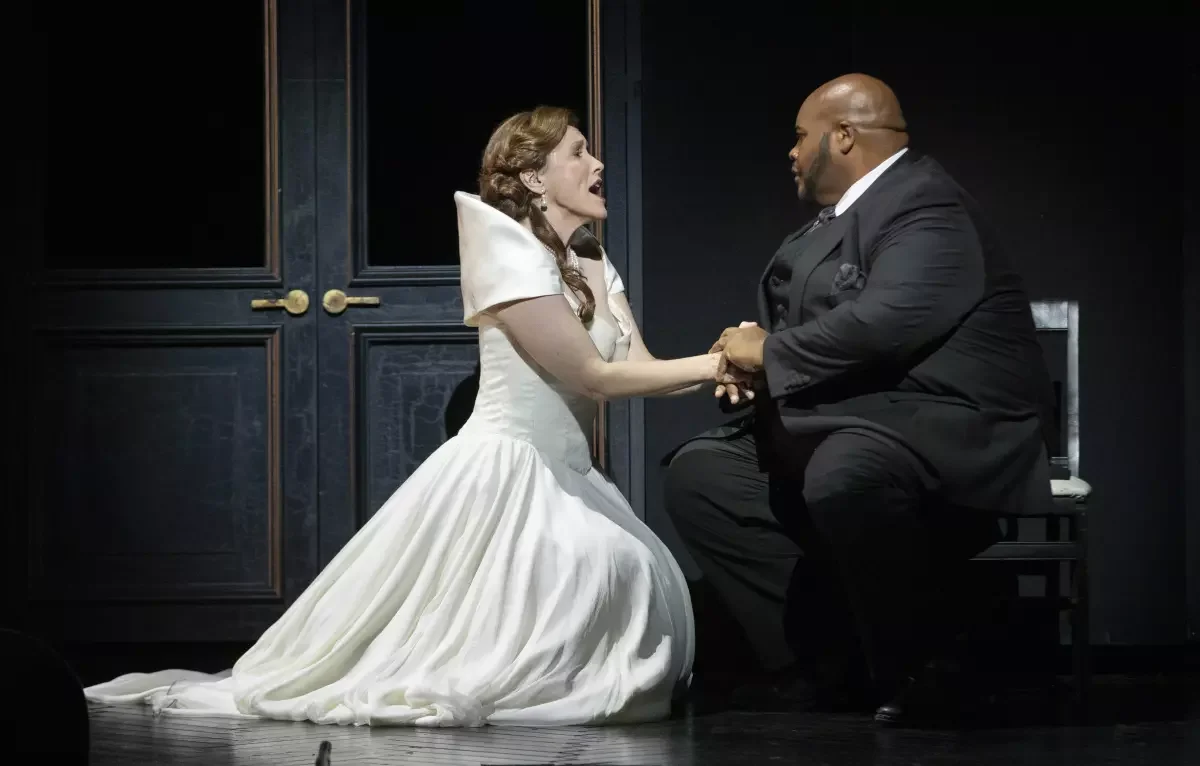
Tannhäuser dramatizes this theological divide. The Pope represents the satisfactionist position in its most rigid form: he has assessed Tannhäuser's debt and declared it unpayable. His criterion, that his own dry staff would sooner bloom than Tannhäuser receive grace, is an assertion of absolute proportionality. The sin is too great. No amount of Buße will suffice.
The opera's miraculous conclusion, the staff blooms, is Wagner's answer to this. Grace arrives precisely where the institutional arbiter declared it impossible. This is not a vindication of Tannhäuser's conduct. It is a critique of the system that claimed authority to measure and dispense it.
Grammatik und Gebrauch / Grammar and Usage

Buße is a feminine noun. Its declension is regular.
Key verb: Buße tun, to do penance, to atone. This is the standard religious construction: Er tat Buße für seine Sünden (He did penance for his sins). Also büßen (v.), to atone, to pay for: Das wirst du büßen! You'll pay for that! (Common in everyday speech, usually with an edge of threat or irony.)
Key compound nouns:
Das Bußgeld, a fine, a monetary penalty (the legal usage)
Der Bußgang, a penitential journey, a pilgrimage undertaken as penance (Tannhäuser's journey to Rome)
Der Bußtag, a day of repentance; Buß- und Bettag is a Protestant day of penitence still observed in Germany
Das Bußsakrament, the sacrament of penance (Catholic theology)
Die Bußpredigt, a sermon on repentance, a fire-and-brimstone sermon
Common idiom: etwas büßen müssen, to have to pay for something. Das wird er noch büßen müssen, He'll have to pay for that yet. This everyday usage, completely secular, carries the same transactional logic as the theological concept: an act creates a debt, the debt must be discharged.
Im heutigen Deutsch / In Contemporary German

Buße in its religious sense is primarily encountered in formal religious contexts, liturgy, theological writing, discussions of church history. The Protestant Buß- und Bettag (Day of Penitence and Prayer) keeps the word alive in German cultural consciousness, though its observance is limited since it was removed as a public holiday in most German states in 1995 (retained only in Saxony).
In legal German, Bußgeld is entirely ordinary and current. The word appears on every traffic fine in Germany and Austria. The legal Buße is bureaucratically routine. The theological Buße is increasingly specialized. But the verb büßen remains active in everyday speech in its idiomatic sense. Das wirst du noch büßen, You'll pay for that, appears in conversations, films, and novels as a formula of implied justice, invoking the concept's deep structure (wrongdoing creates a debt that will be repaid) without any religious content.
Verwandte Wörter / Related Words

Büßen (v.), to atone, to pay for (legal and idiomatic)
Das Bußgeld, fine, penalty fee
Der Bußgang, penitential journey
Die Reue, remorse, contrition (the emotional precondition of Buße)
Die Sühne, expiation, atonement (related but implies a more complete making-amends)
Die Absolution, absolution (the grant of forgiveness after penance — what Tannhäuser seeks)
Die Gnade, grace, mercy (what the Pope withholds and the blooming staff demonstrates)
Vergeben (v.), to forgive
Beichten (v.), to confess (the act that precedes Buße)
Die Beichte, confession
Verbessern (v.), to improve, to correct (shares the etymological root)
Die Verbindung zum Weg / Connection to the Walk

Old St. Patrick's Old Cathedral is the February walk's Rome. Standing outside its gates while the Rome Narrative plays, Inbrunst im Herzen, you are present at the opera's moment of maximum Buße and maximum refusal. Tannhäuser has made the journey. He has performed the Bußgang in its most extreme form, denying himself every comfort the other pilgrims accepted. And the institutional authority has said: not enough.
The walk's instruction is to approach the cathedral first in silence, letting the architectural shift do its work before the music begins. This is correct procedure for Buße as a concept. The penitent arrives with their body already prepared through the journey, already humbled by distance and weather and physical suffering, before any words are spoken. The silence before Old St. Patrick's is your body arriving at the point of reckoning.
The walk also uses the cathedral's own history as a layer of meaning. Old St. Patrick's was fortified against anti-Catholic mobs in the 1830s. The congregation's right to gather, to practice their faith, to be recognized as legitimate citizens, all of this was actively contested. They came to this building seeking something like what Tannhäuser sought in Rome. Recognition, legitimacy, the right to be included in the moral community. Sometimes they got it. Sometimes, like Tannhäuser, they were told their claim was insufficient.
Buße asks a harder question than it first appears. Not just what must be paid? but who has the authority to set the price? The Pope, the bishop, the anti-Catholic mob, the legal system, the community, all claim that authority at various moments. Tannhäuser is an opera about the moment when that claim is challenged and found wanting.
Wer setzt den Preis fest? Who sets the price? The question echoes across the walk's geography. From the Stadttheater ground where Wagner's German conflict entered American cultural life, to the park where tenement clearance tried to pay a social debt with open space, to the cemetery behind the cathedral walls where people who were refused legitimacy in life now rest in consecrated ground. The Buße is always being made somewhere. The question is always whether it is accepted.
Further Reading