What Knowing Would Destroy: On Geheimnis
Das Wort / the word: das Geheimnis (n.), pl. die Geheimnisse
Aussprache / pronunciation: geh-HYME-nis
Wortart / part of speech: Noun, neuter
Register: Broad, from everyday speech (das ist mein Geheimnis, that's my secret) through literary and philosophical usage (das Geheimnis des Lebens, the secret of life) to theological and mystical discourse (das heilige Geheimnis, the holy mystery). One of the most semantically layered words in German.
Was das Wort wirklich bedeutet / What the word actually means

Geheimnis carries a double meaning that English splits into two separate words. It is both secret (something withheld from others who might want to know it) and mystery (something that exceeds ordinary understanding, that cannot be fully grasped or explained). In English, a secret is something someone is hiding. A mystery is something that resists comprehension. The two are related but distinct. You can know a secret and tell it, after which it ceases to be secret. A mystery, if it is genuine, cannot be dissolved simply by telling. It retains its character of exceeding full comprehension even when named.
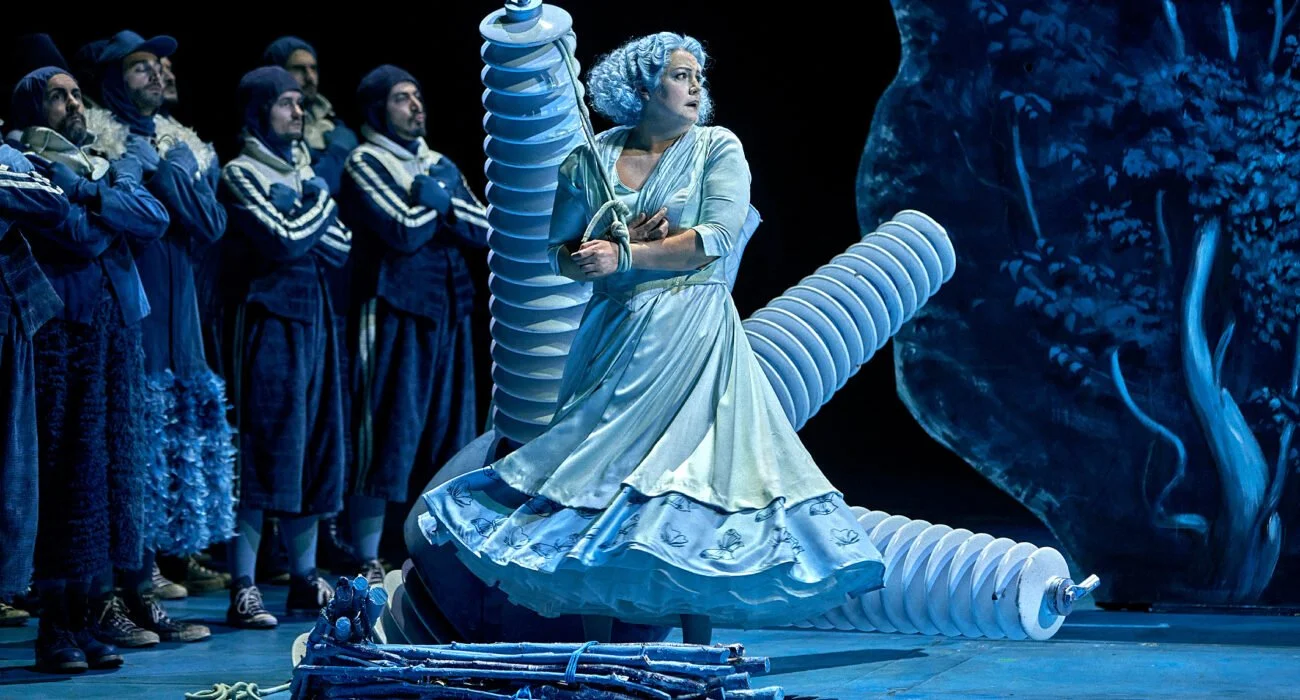
German Geheimnis inhabits both. And Lohengrin depends on this double inhabitation entirely. The knight's identity is both a secret (he knows it, the others do not, it is being withheld) and a mystery (it comes from the realm of the Grail, which is by definition beyond ordinary human comprehension). When Elsa asks the forbidden question and Lohengrin answers, naming himself, explaining his origin, the secret is resolved but the mystery remains. He was from Monsalvat. He served the Grail. But Monsalvat is not less mysterious for being named. It is, if anything, more so. The answer to Elsa's question does not demystify the knight. It simply confirms that he was something her world could never have fully accommodated, and returns him there.
This is why the word Geheimnis is so precisely right for the opera. A secret disclosed closes itself down. There is no more secret. But a mystery disclosed does not close itself down. It opens onto further mystery. The opera ends not with resolution but with revelation in the full sense, with something made more present by the naming, not less.
Die Etymologie: Das Heim im Geheimnis / The Home in the Secret

Geheimnis is formed from the adjective geheim (secret, private, hidden) plus the suffix -nis (which forms abstract nouns: Kenntnis from kennen, Erlaubnis from erlauben, Finsternis from finster). The suffix creates a noun naming the quality or state.
The adjective geheim comes from Old High German gaheim, ga- (a perfective prefix) + heim (home). The etymological sense is at home or belonging to the household, with the later development of kept at home, kept within the domestic sphere, not for outside eyes. What is geheim is what belongs to the private interior, what has not been brought into public view. Heim, home, is embedded inside Geheimnis. The secret is what is kept at home. What is not brought outside. What remains within the intimate, domestic, private sphere.
This etymology illuminates the opera in an unexpected direction. Lohengrin's Geheimnis is quite literally geheim in the original sense. It belongs to a world that is his home (Heim) but not Elsa's. Monsalvat is the Grail realm, his home, his origin, the domestic world he comes from. When the secret is disclosed, he does not remain in the world into which he has arrived. He returns home. The Geheimnis was always his Heim, his interior, his not-for-outside-eyes. Elsa's question forces it into the outside. And once outside, it can no longer coexist with her world.
The related word die Heimlichkeit (secrecy, concealment) preserves the Heim root even more directly, heimlich means secret, covert, clandestine, literally home-like, domestic, of the interior. Freud's essay Das Unheimliche (The Uncanny), which we encountered in January, draws explicitly on the heim root. The uncanny is the unheimlich, the not-home-like, the familiar turned strange, the interior made exterior in a disturbing way. The Dutchman in January was unheimlich. Lohengrin is the opposite. He brings the heimlich, the interior, the home-world of the Grail, into the public world of Elsa's court, and the problem is that it cannot stay there.
Geheimnis und das Heilige / Secret and the Sacred

The theological dimension of Geheimnis, its meaning as mystery rather than secret, is central to Christian liturgical language, and particularly to the Catholic and Lutheran traditions that shaped German cultural vocabulary.
Das heilige Geheimnis, the holy mystery, is the phrase used for the mysteries of faith. The Eucharist, the Trinity, the Incarnation. These are Geheimnisse not in the sense of facts being withheld (the Church announces them publicly) but in the sense of truths that exceed full human comprehension. They are mysteries because they cannot be adequately grasped by reason alone, because they retain their depth even after full doctrinal articulation, because the act of naming them does not exhaust them.
The theological usage explains why the Grail is so precisely captured by Geheimnis. The Grail in Wagner's mythology, already established in Lohengrin and reaching its full development in Parsifal, is a sacred mystery in the liturgical sense. A holy object whose power operates through faith and ritual, not through rational understanding. The Grail knights are guardians of a Geheimnis that must not be profaned by exposure to a world not prepared to receive it. When Lohengrin arrives in Brabant, he brings the Grail's power with him, but the condition of that power is precisely that its source not be interrogated, not be brought into the ordinary register of causes and explanations. The Geheimnis of the Grail is structurally incompatible with the public demand for transparent origins that Elsa is eventually pressured to voice.
The Lutheran tradition's relationship to mystery is somewhat different from the Catholic. Luther's emphasis on scripture alone, on the clarity and accessibility of God's word, made him suspicious of mystical obscurantism. Of a Geheimnis that the Church kept artificially veiled to protect its institutional authority. The tension between Geheimnis as genuine mystery and Geheimnis as maintained secrecy for power's sake runs through both Reformation theology and through Lohengrin. Is the knight's silence a genuine condition of his power, or is it an exercise of authority that keeps Elsa permanently subordinate?
Das Geheimnis in der Literatur / Secret and Mystery in Literature

German Romanticism, as with so many of the year's vocabulary words, is the primary cultural context for Geheimnis as a literary concept. The Romantics placed mystery at the heart of aesthetic experience. The artwork that fully discloses itself, that has no depth beyond what is immediately visible, was for them a failure. Great art must have a Geheimnis, something that resists complete comprehension, that sustains repeated encounter, that rewards the return.
Novalis, whose mystical poetry and fragmentary novel Heinrich von Ofterdingen are central texts of German Romanticism, made this explicit. For Novalis, the world is layered with hidden meanings accessible only through the right kind of attention, a kind of Ahnung (intuition, premonition) rather than rational analysis. The blue flower of Heinrich von Ofterdingen is a symbol of Geheimnis in this precise sense. It draws the protagonist onward through yearning rather than through knowledge, it promises a significance that cannot be fully articulated.
Wagner inherited this Romantic aesthetics of mystery directly. The Prelude to Lohengrin, described in the walk's framing as light filtering down from the Grail realm, as a vision before form, is the musical enactment of Geheimnis. Something is present that cannot be grasped directly, something that reveals itself gradually and partially, something that retains its character of mystery even as it becomes more audible. The Prelude does not explain the Grail. It presents it as a Geheimnis, an experience of being-in-the-presence-of-something-beyond-comprehension.
Grammatik und Gebrauch / Grammar and Usage

Das Geheimnis is neuter. It declines regularly and has a standard plural. Note the genitive singular: des Geheimnisses, the double s is standard for nouns ending in -nis.
Key adjective: geheimnisvoll, mysterious, enigmatic, full of mystery. One of the richest compound adjectives in German: -voll (full of) attached to Geheimnis. A geheimnisvoller Fremder is a mysterious stranger, someone whose nature is felt to exceed what is visible. The walk's Lohengrin, arriving by swan boat, is geheimnisvoll before he is anything else.
The adjective geheim: secret, classified, covert. Streng geheim, top secret (literally: strictly secret). Geheimdienstler, intelligence agent (literally: secret service person). Das Geheimfach, the secret compartment. These everyday compounds show how thoroughly geheim has infiltrated the vocabulary of concealment and classified information.
Common constructions:
Ein Geheimnis wahren / hüten, to keep / guard a secret
Ein Geheimnis lüften, to lift / reveal a secret (the verb lüften, to air out, is beautifully physical: you lift the veil)
Kein Geheimnis daraus machen, to make no secret of it
Das ist sein Geheimnis, that's his secret / that's his business
Es ist ein offenes Geheimnis, it's an open secret
Verwandte Wörter / Related Words

Geheim (adj.), secret, classified, private
Die Heimlichkeit, secrecy, stealth, concealment
Heimlich (adj.), secret, covert, furtive; also: intimate, homely (the word Freud worked with)
Das Mysterium, mystery (borrowed from Latin; slightly more formal and theological than Geheimnis)
Geheimnisvoll (adj.), mysterious, enigmatic
Verschweigen (v.), to conceal, to keep silent about (to maintain a Geheimnis through Schweigen)
Enthüllen (v.), to reveal, to unveil (the opposite act: bringing a Geheimnis into the open)
Das Rätsel, riddle, puzzle (a Geheimnis that invites solution; distinct from the mystery that resists it)
Das Tabu, taboo (the social prohibition that enforces keeping a Geheimnis)
Unheimlich (adj.), uncanny (the Geheimnis made strange, the interior turned exterior)
Das Heilige, the sacred, the holy (the theological relative of Geheimnis in its mystery-meaning)
Die Verbindung zum Weg / Connection to the Walk

The Roerich Museum is the walk's Geheimnis in architectural form. A small, easily missed townhouse on a residential Upper West Side block, housing the work of a Russian mystic who saw Himalayan mountains as visual correlates of Wagner's Grail. Nearly hidden from the street, the walk describes it this way deliberately. It is not announced. It does not proclaim itself. It is a Geheimnis in the city's texture. Something that contains more than it shows, that rewards the commitment to seek it out, that keeps its depth from those who do not stop.
This is what great Geheimnisse do. They reveal themselves proportionally to the attention brought to them. The Roerich paintings are not beautiful from a glance-and-move-on position. They are beautiful from the geheimnisvoll position. The slow gaze, the willingness to let a Himalayan temple become Monsalvat, the patience to sit with a canvas and let it do what it is doing rather than registering it and moving on.
The Prelude's famous opening, which the walk stages at the reservoir's waterline, is Geheimnis made acoustic. Those very high, quiet strings are not announcing anything. They are presenting something in the way a Geheimnis presents itself. Barely, at the edge of perception, requiring you to lean toward it. The music does not fill the space the way the Bacchanale or the Bridal Chorus fills it. It occupies it lightly, provisionally, as if it might at any moment withdraw back into the inaudible. You have to hold very still to receive it.
In Fernem Land, unnahbar euren Schritten, In a far land, unapproachable to your steps. Lohengrin's great aria, heard inside the Roerich Museum surrounded by painted mountain sanctuaries, is the opera's Geheimnis fully named. The Grail realm is real, it is where he comes from, it is where he must return. The naming does not dissolve the mystery. It deepens it. You are hearing the description of a place you will never reach, from someone who belongs there and is now going back. The Geheimnis was always the Heim. And now it is receding westward over the Hudson, and you are left on the bank with what you know, which turns out to be both more and less than you hoped.
Das Geheimnis schützt sich selbst. The mystery protects itself. You cannot hold it against its will. You can only be present to it while it consents to remain.
Further Reading