From Surfaces to Duration: Rethinking Urban Attention as a Response to Heinz Paetzold
Heinz Paetzold’s 2013 essay The Aesthetics of City Strolling is an argument for walking as a way of knowing. Not knowing about the city, but knowing through it. He treats walking neither as exercise nor as transit, but as a mode of perception in which the city discloses itself bodily, atmospherically, and all at once. Meaning does not arrive through analysis. It arrives as a felt totality. Rhythm, light, sound, density, pace, before it ever becomes thought. Paetzold’s claim is simple and demanding. The city is first experienced as atmosphere, and only later as explanation.
This matters because it restores seriousness to a practice most modern cities try to eliminate. Unpurposed walking has become an inconvenience to traffic systems, to real estate logic, to productivity culture. Paetzold insists it is instead a primary aesthetic activity of modern urban life. To move through the city at walking speed, without a fixed goal, allows the city’s character to impress itself on the body. Streets, squares, stations, riverbanks, crowds. These are not neutral backdrops. They exert pressure. They tune perception. They shape feeling before interpretation has time to intervene.

Paetzold’s account is grounded in phenomenology rather than nostalgia. He resists the idea that urban experience is dominated by sight alone. Walking involves the whole sensorium. The cadence of steps, the resistance of crowds, the acoustics of spaces, the way smell and temperature settle into memory. He draws on Cassirer’s notion of symbolic pregnance to argue that perception already carries meaning in its first encounter. We do not assemble meaning from fragments. We encounter it whole, and only later refine it. The city, encountered through walking, speaks in this pre-reflective register.
There is also a distinct institutional and cultural lineage behind this way of thinking. Paetzold’s career passed through European academies which treated everyday practices as legitimate philosophical material, including the Jan van Eyck Academie, where theory was never fully separated from lived experience. For those of us who studied there while Paetzold was head of theory, this essay reads less like an abstract argument and more like a familiar atmosphere. Walking, listening, lingering, allowing oneself to be affected. These were not indulgences but methods. Thinking was expected to emerge from attention rather than control.
Paetzold’s essay describes walking as a solitary practice, one that allows immersion without obligation, observation without performance. The walker is carried by the crowd rather than opposed to it. Identity loosens. Attention widens. This description still resonates, but it now carries friction. The conditions that once made this form of walking readily available have changed. Aimlessness no longer arises by default. It has to be defended.
In cities like New York, walking now takes place inside overlapping systems which constantly seek to direct, measure, or monetize attention. Navigation tools pre-structure routes. Notifications fracture continuity. Surveillance and reputation systems erode the anonymity Paetzold took as given. Even when walking alone, one is rarely unaddressed. The bodily rhythm Paetzold describes still exists, but entering it now requires active resistance to interruption.
This shift also complicates Paetzold’s contrast between European and American traditions of urban thinking. He suggests that European approaches are historically layered while American ones attend more strictly to the present. New York unsettles this distinction. It is aggressively present-tense. Fast, crowded, transactiona, yet saturated with absence. Entire neighborhoods, shorelines, and communities exist only as traces beneath the grid. The experience of walking here is not a comparison with a visible past, nor a neutral sampling of the present, but an encounter with what has been erased, buried, or priced out. Memory in New York is infrastructural rather than monumental.
Paetzold’s use of Michel de Certeau contends that walking in itself is a form of expression. Just as speech operates within a language system while bending it through individual utterance, walking operates within the city’s spatial order while subtly reworking it. Routes are improvised. Shortcuts are invented. Detours become statements. Through this, walking produces a second, poetic geography layered over the official one. Power designs the city for efficiency. Walking answers with ambiguity and play.

Paetzold proposes that contemporary street art is the walker’s primary artistic encounter. Ephemeral, politically charged, resistant to institutional capture. In 2013, this reading still held. Today, it feels incomplete. Street art remains capable of surprise, but it no longer reliably functions as an outside force. In New York especially, it has been absorbed into branding, tourism, and real estate signaling. Murals often arrive alongside rising rents, not against them. Even unsanctioned work is quickly photographed, circulated, and converted into content. The city swiftly learned how to metabolize critique as texture. Visual intervention alone no longer guarantees aesthetic or political disruption.
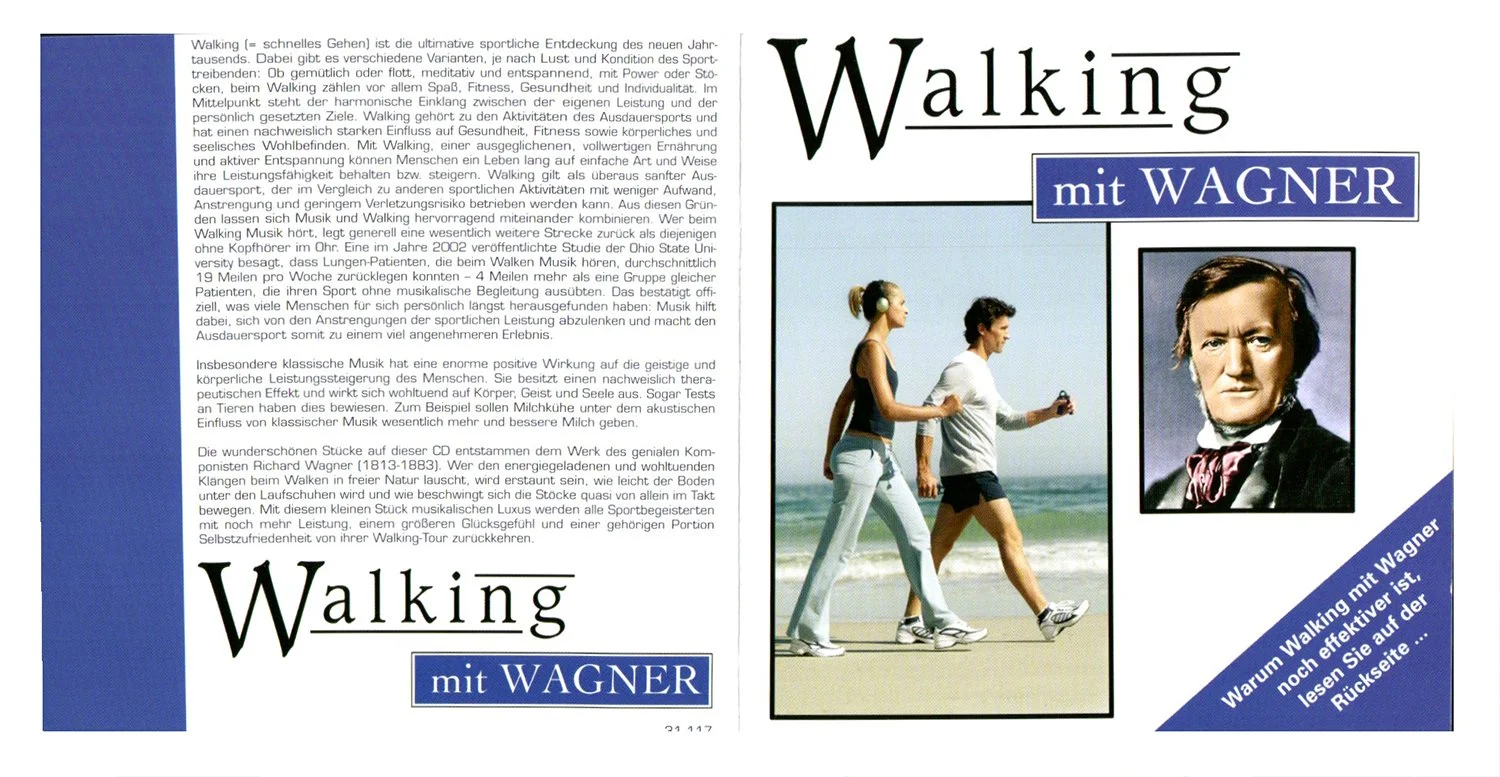
Aufbruch/Matt proposes a different alignment. Not visual interruption, but temporal reorientation. Music carried through walking does not intervene at a single point. It reshapes duration itself. Where street art punctuates space, music sustains an atmosphere. It does not compete with the city’s surfaces. It reorganizes how those surfaces are felt over time.
Paetzold already gestures toward sound when he references composers who worked with urban noise, but he treats music primarily as an object which reflects the city. Aufbruch/Matt treats it as a companion practice. Music becomes a second atmosphere layered onto the first. It does not remove the walker from the city. It deepens the encounter. Crowds become choral rather than oppressive. Repetition becomes motif rather than annoyance. Distance acquires shape.
This matters because the contemporary city exerts pressure through tempo as much as through space. Speed, interruption, and urgency are not accidental byproducts. They are structural features. Music offers a way to remain inside the city while refusing its default emotional pacing. It restores continuity where attention is otherwise fragmented. It allows walking to remain porous rather than defensive.
Seen this way, Aufbruch/Matt does not reject Paetzold’s project. Rather it extends it under altered conditions. Paetzold argued that walking transforms everyday life into an aesthetic practice by heightening sensibility. That remains true. The question now is which practices can still sustain that transformation without being absorbed by the city’s economic and representational machinery. Music, unlike surfaces, resists capture. It cannot be zoned, branded, or preserved as evidence. It exists only in time.
Paetzold believed that walking culminates in art, and that art flows back into everyday life. I argue the direction now runs the other way. Art must function as a scaffold which allows everyday life to remain perceivable at all. In a city which constantly accelerates, music reclaims duration. It restores the conditions under which walking can still operate as a way of knowing rather than merely moving.
Paetzold’s essay remains valuable because it insists cities are not understood through concepts alone. They are understood through bodies in motion. What has changed is the degree to which that motion is now contested. Aufbruch/Matt takes Paetzold’s insight seriously enough to adapt it. Walking remains the method. Atmosphere remains the object. Music becomes the means by which attention is protected long enough for the city to speak.
Further Reading