Kill the Wabbit: On Seeing Wagner Everywhere
It started with a dog food commercial. The Rheingold prelude. One hundred and thirty-six bars of a single E-flat, the most patient piece of music ever written, Wagner's attempt to render in sound the moment before the world existed. The low strings hold the note and the arpeggios build so slowly that you cannot hear them moving, only arriving, and by the time the full orchestra has assembled itself out of that original hum you have the sensation of having witnessed something geological. The primordial deep. The formation of matter. The world coming into being out of nothing.
Selling dog food.

I sat with this for longer than the commercial deserved. Not because it was offensive, exactly. Because it was funny in a way which then stopped being funny and became a question. What happens to a piece of music which carries that much intention when it is removed from its context and put to work on something else entirely? Does the meaning travel with it? Does it dissolve? Does it do something stranger, which is to attach itself to the new context and make the new context briefly, absurdly enormous?
For a moment, watching that commercial, the dog food felt cosmically significant. Then the moment passed. There is a phenomenon called the Baader-Meinhof effect. You encounter something for the first time, a word, an idea, a name, and then you begin seeing it everywhere. The explanation is selective attention. The thing was always there. You lacked the category to notice it. Now you have the category and the world obliges by filling it.
The film Der Baader Meinhof Komplex was on my German cinema watchlist before I knew the phenomenon shared its name. I watched the film and then looked up the phenomenon and sat for a moment with the coincidence, which was not a coincidence at all but exactly the kind of thing which happens when a project begins to organize your attention around a particular set of ideas. The world does not change. The attention does. And then the world appears to change. This is what has been happening with Wagner.
Two months into this project and he is everywhere. Not because I am projecting him. Because he is actually there, in places I had been looking at for years without the category to see him. The Baader-Meinhof effect and the actual frequency are both true at the same time. The attention has been recalibrated and the culture has been full of Wagner for a hundred and fifty years. Both things are simultaneously correct.
The Ride of the Valkyries. You know it even if you don't know you know it. Francis Ford Coppola put it in Apocalypse Now in 1979, helicopters descending on a Vietnamese village at dawn with the brass section doing what the brass section does, and the sequence is so precisely right, so accurate about what the music contains, that it is almost impossible to hear the piece now without the helicopters arriving. Coppola understood something Wagner built into the music which most concert performances obscure. The Valkyries are not noble. They are terrifying. They ride across the sky collecting the bodies of the dead. The music is not triumphant. It is annihilating. Put it under helicopter gunships and you are not misusing it. You are restoring it. This is Wagner in contemporary culture at its most honest. The violence the music always contained, recognized and used accurately.

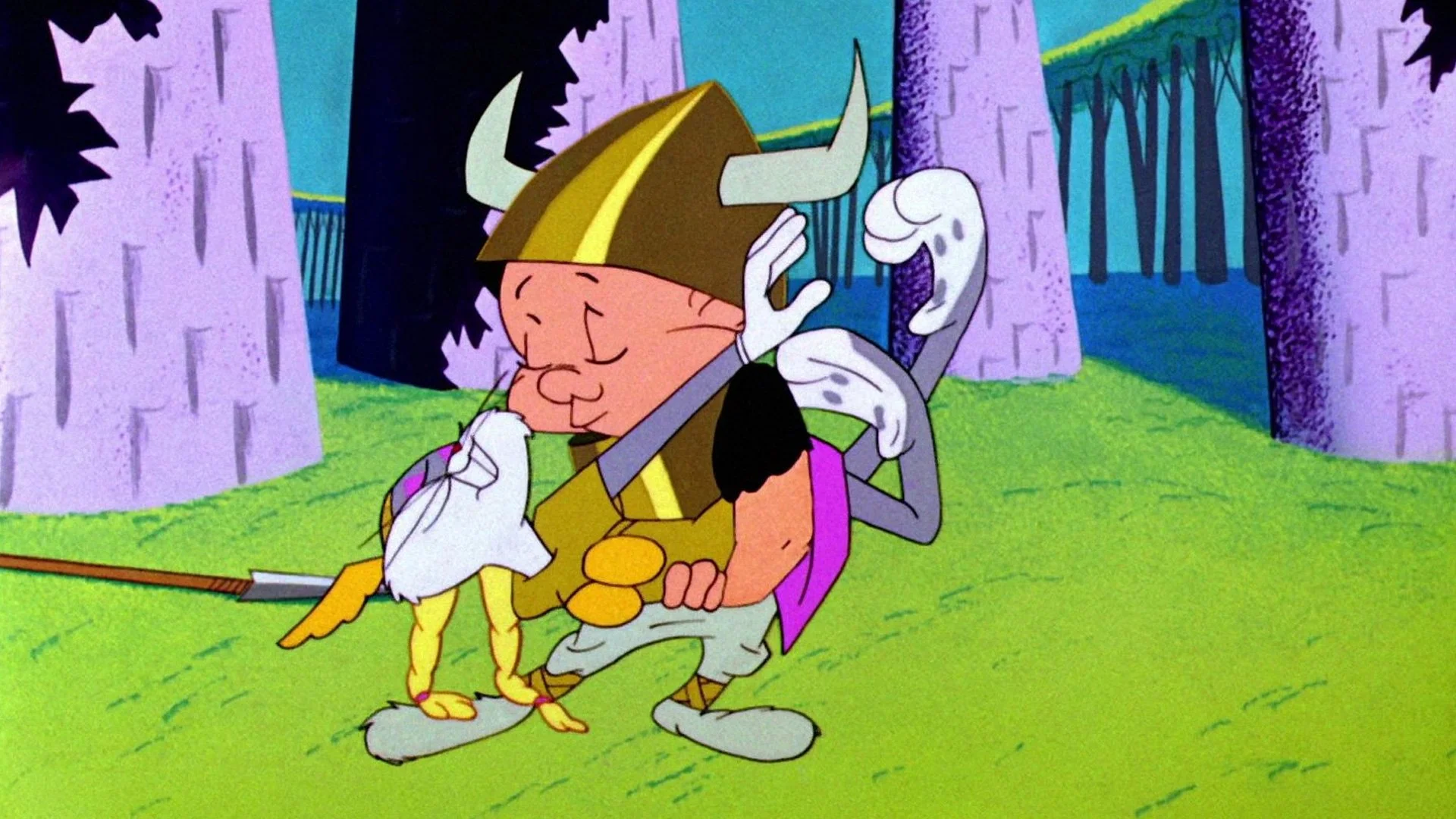
Then there is What's Opera, Doc. The 1957 Bugs Bunny cartoon in which Elmer Fudd pursues Bugs Bunny through a compressed version of the Ring Cycle, singing kill the wabbit to the Ride of the Valkyries and ending with Bugs dead in Elmer's arms while the Funeral Music plays. Chuck Jones knew the operas. The parody is precise. The leitmotifs are used correctly. Bugs dies wrapped in Brünnhilde's costume and Elmer grieves and then looks at the camera and shrugs. It is seven minutes long and it has probably introduced more people to the structure and emotional logic of Wagner's music than any production at any opera house has. The American Film Institute named it the greatest cartoon ever made. Wagner would have hated it and been unable to deny that it worked.
The Lohengrin Bridal Chorus. Here Comes the Bride. Played at more Western weddings than any other piece of music ever written, heard so many times in that context that most people who hear it have no idea it comes from an opera about a knight who arrives on a swan and leaves when his wife asks his name. The marriage it accompanies in Lohengrin ends in catastrophe. The knight departs. Elsa dies. The piece is not a celebration of marriage. It is the processional into a tragedy. Every bride who has walked down an aisle to it has been unknowingly accompanied by one of the most doomed marriages in the operatic repertoire.
This is Wagner in contemporary culture at its most thoroughly stripped of context. The music survives the stripping. It still works as a processional. But something is lost, which is the weight the music was written to carry. John Williams did not invent the Force theme. He learned it from Wagner and applied it to space.
This is not a criticism. It is a description of how influence works, and Williams has said as much himself. The leitmotif structure of the Star Wars scores, persistent musical ideas attached to characters and concepts which develop and transform across the duration of a long narrative, is Wagner's technology applied by someone who understood it deeply to a new mythology for a new audience. When the Force theme builds under the twin suns of Tatooine at the end of a long day, that is the Grail motif in a different key. When Darth Vader's theme arrives and you feel the weight of inherited darkness, that is the Curse motif translated into brass and menace.

The From Twin Suns to Valhalla essay touched this. But living inside the project makes it more specific. Walking through New York with the Ring in my headphones and then sitting in a cinema watching something else and hearing the leitmotif logic underneath the score, the thing which recurs and develops and carries memory forward through the narrative, is no longer an intellectual observation. It is a somatic one. The body recognizes the structure. The attention has been trained to feel it. This is what the project is doing which I did not fully anticipate when it began.
It is not only teaching me to hear Wagner. It is recalibrating the apparatus which hears everything else. Two months of scored walks and Duolingo mornings and German films and accumulated essays has built something in the attention which was not there before. A sensitivity to certain kinds of musical and linguistic structure. A capacity to feel the difference between music which carries duration and music which consumes it. Between language which accumulates meaning across repetitions and language which uses words as disposable containers.
The dog food commercial landed because the attention could feel the gap between what the music was built to carry and what it was being asked to carry. Six months ago it would have been background. Now it is legible. The category exists and the world is filling it.
The Baader-Meinhof effect named itself after a German terrorist organization which became suddenly visible to the person who coined the term after reading about it for the first time. I watched the film about that organization as part of my German cinema practice. The film is relentless and precise and does not explain itself, in the way which German cinema at its best does not explain itself. There is no Wagner in it. But the attention which the project has been building is present while watching it. The capacity to follow something difficult at its own pace without demanding resolution. The tolerance of partial understanding. The willingness to stay inside a duration which has not yet declared what it means. That capacity came from the walks. From the operas. From the German accumulating word by word in the early mornings before the day begins.
Wagner is everywhere because Wagner built the infrastructure which Western culture has been running on for a hundred and fifty years without always knowing it. The leitmotif in the film score. The extended harmonic language which made the late Romantic tradition possible. The idea of the Gesamtkunstwerk, the total work of art which integrates music, drama, and visual design, which is what cinema has been attempting since it learned to synchronize sound.
He is in the dog food commercial. He is in the Bugs Bunny cartoon. He is in the wedding processional and the helicopter gunships and the twin suns of Tatooine. He is in the silence Das Lehrerzimmer builds its tension from and in the leitmotif logic underneath the Star Wars score and in the harmonic language which makes a minor chord in a film score feel like grief without anyone having to explain it.
The project did not put him there. The project gave me the category to see what was already there. The category is the thing. Build it carefully enough and the world reorganizes itself around it. The walks, the operas, the German at 7am, the field notes taken in motion. These are not supplementary to the project. They are the mechanism by which the category is built. The dog food commercial comes on again. The primordial E-flat fills the room. The world forms itself out of nothing. The labrador seems pleased with his dinner.
Further Reading