The Risk You Take on Another Person: On Vertrauen
Das Wort / the word: das Vertrauen (n.), no standard plural
Aussprache / pronunciation, fer-TROW-en
Wortart / part of speech, Noun, neuter; also the infinitive nominalization of the verb vertrauen
Register, Everyday and elevated simultaneously, Vertrauen is entirely ordinary in daily speech (it appears in conversations about relationships, institutions, professional life) while also carrying philosophical depth in discussions of social contract, ethics, and psychology.
Was das Wort wirklich bedeutet / What the word actually means

March has two thematic words that appear to be synonyms and are not, Glaube and Vertrauen. Both are often translated as trust or faith in English, which flattens a distinction the German language maintains carefully, and which the opera depends on precisely. Understanding the difference between them is one of the most useful things March's vocabulary study can offer. Not just linguistically, but as a way of grasping what exactly Lohengrin is asking of Elsa, and what exactly she fails to give.
Glaube, as the preceding article explored, is oriented toward propositions and entities. You believe something is true, or you believe in something as real and worthwhile. It has a philosophical and theological weight. It is personal and intimate, but its object can be abstract. A doctrine, a deity, a principle.
Vertrauen is interpersonal and relational. You trust a person. You place Vertrauen in someone who has the capacity to act, to deceive, to keep or break a promise. Vertrauen is inherently vulnerable. It requires you to expose yourself to the possibility of being let down by another agent. The philosopher Annette Baier, writing in English, defined trust as reliance on another's goodwill toward oneself. What distinguishes trust from mere reliance (you can rely on a calculator) is that the person you trust has the option to harm you, and you proceed despite that option, because you extend goodwill to them.
This vulnerability is what Lohengrin is asking Elsa to sustain. He is not asking her to believe an abstract proposition. He is asking her to trust him. To extend, indefinitely and unconditionally, the reliance on his goodwill even though he gives her no grounds for that goodwill except his presence and her instinct. Vertrauen of this radical kind is the hardest thing the opera demands. And it is what Ortrud, with forensic psychological precision, attacks.
Die Etymologie / Etymology

Vertrauen combines the prefix ver- with trauen, an older verb meaning to trust, to dare, to venture. Trauen is still active in modern German in two distinct uses that illuminate the word's range:
Sich trauen, to dare, to have the nerve to do something. Ich traue mich nicht, ihn anzusprechen, I don't dare speak to him. The reflexive construction has the sense of summoning internal courage.
Jemanden trauen, to trust someone. In the specific ritual sense, to marry someone. Der Pfarrer traut das Paar, the priest marries the couple. This is the same verb. The wedding ceremony is etymologically an act of Trauen, a mutual extension of trust formalized before a community and a ritual authority.
This connection between trust and marriage is not incidental to Lohengrin. The opera's central action is a wedding in which the condition of Vertrauen is explicitly negotiated as a prerequisite for the union. The knight will marry Elsa on condition of her trust. When that trust fails, the marriage fails, not as a conventional dramatic consequence but as a logical necessity. The wedding was the Vertrauen. When the Vertrauen is withdrawn, the wedding is retroactively undone.
The prefix ver- in vertrauen intensifies and formalizes the base trauen. To have fully committed trust in someone, to have given one's trust over to them. The ver- marks a completion, a handing-over. Your trust is not tentative or hedged; it has been placed, delivered, entrusted.
Vertrauen als soziales Konzept / Trust as Social Concept

In the social sciences, Vertrauen has become one of the central analytical concepts of the 20th and 21st centuries. The sociologist Niklas Luhmann, one of the most significant German social theorists of the postwar period, wrote extensively on Vertrauen as a mechanism for managing social complexity.
Luhmann's argument, compressed, is that modern society is too complex for any individual to verify the trustworthiness of every system, institution, and person they interact with. You cannot personally audit your bank, verify the safety testing of your food, evaluate the credentials of your doctor, or confirm the structural integrity of every bridge you cross. You trust, not individual persons, primarily, but systems. Institutions, credentials, protocols, reputation mechanisms. This systemic trust (Systemvertrauen) is what allows modern society to function. It is also extraordinarily fragile. A single bank failure, food contamination scandal, or medical fraud can destroy trust in the entire system category, making everyone suddenly aware that they have been vertrauen-ing in something they cannot personally verify.
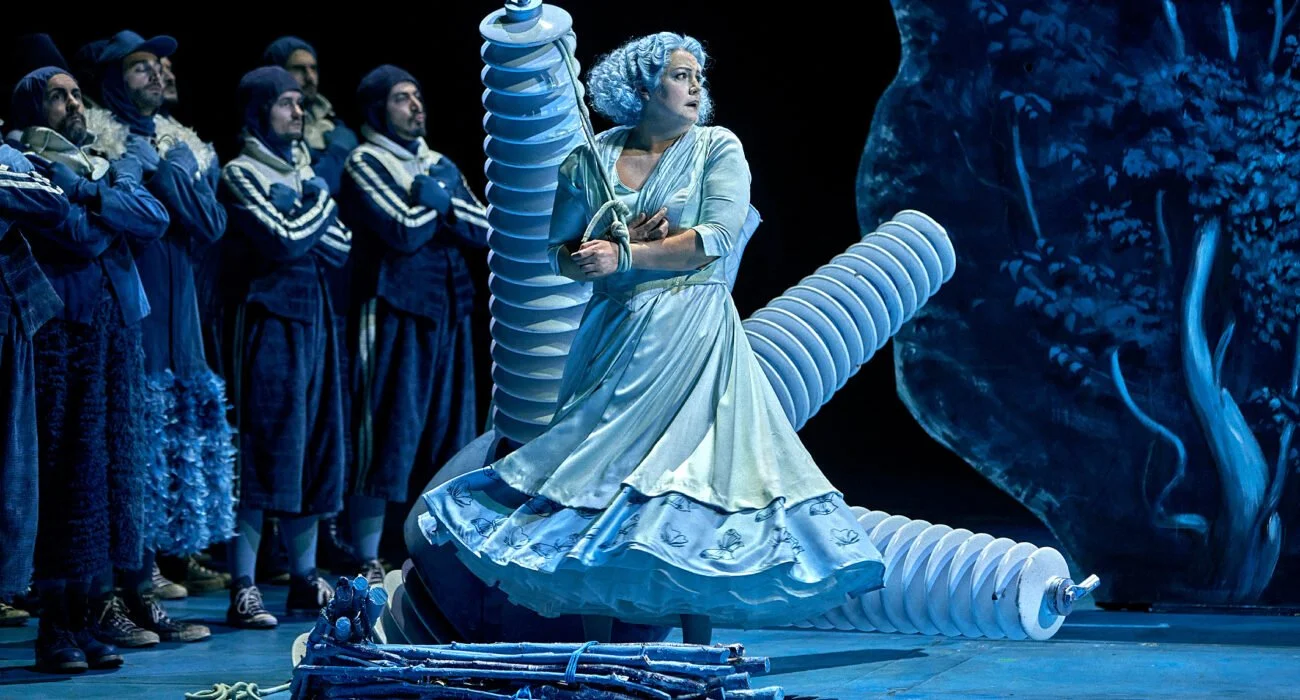
Lohengrin stages a pre-modern version of this problem. Elsa's trust in the knight is interpersonal and unmediated. She cannot appeal to any institutional verification mechanism. But the social world around her does have such mechanisms: the legal trial by combat, the king's court, the community's judgment. The opera's tragedy is that these social mechanisms are themselves corrupted (Ortrud and Telramund are cheating the system) precisely at the moment Elsa most needs them. She is left with pure personal Vertrauen, and personal Vertrauen is, as Luhmann would recognize, terrifyingly exposed.
Vertrauen und Misstrauen / Trust and Mistrust

German handles the negation of Vertrauen with a single word that is both exact and culturally interesting. Misstrauen, mistrust, distrust, suspicion. The Miss- prefix (from Old High German missi-, meaning wrongly, badly, amiss) marks a wrong kind of Trauen, a trust gone sideways, a disposition of wariness and suspicion where trust should or might otherwise exist.
Misstrauen is not simply the absence of Vertrauen. It is its active inverse. Where Vertrauen extends goodwill and vulnerability, Misstrauen withholds goodwill and protects against vulnerability. Where Vertrauen says I will proceed as if your intentions toward me are good, Misstrauen says I will proceed as if your intentions toward me may be bad.
Ortrud's entire dramatic function in Lohengrin is to install Misstrauen in Elsa's mind. She does not destroy Elsa's Vertrauen directly, she could not, from outside. She cultivates Misstrauen, watering it with insinuations, doubts, and the rhetorical insistence that love without knowledge is simply naivety dressed as faith. By the time Elsa breaks silence, she is not acting from strength or rationality. She is acting from Misstrauen, from the fear that she has been deceived, that her vulnerability has been exploited, that her Vertrauen was misplaced.
The opera's moral structure is not simple. Ortrud's position, that Elsa is being dangerously naive, that trust without knowledge is reckless, is not entirely without logic. It is simply corrosive. The problem is not that doubt is irrational, but that the moment doubt is allowed into the specific relational structure Lohengrin has built, it destroys the conditions of the knight's presence. Misstrauen may be epistemically understandable. It is dramatically fatal.
Vertrauen in der Sprache / Trust in Language

Vertrauen generates a rich cluster of related terms and constructions that reveal how thoroughly the concept is embedded in German social and psychological vocabulary:
jdm. Vertrauen, to trust someone (the basic intransitive verb with dative: Ich vertraue dir)
Etwas jdm. anvertrauen, to entrust something to someone (Ich vertraue dir mein Geheimnis an, I entrust my secret to you, note the separable an- prefix marking the act of handing-over)
Das Vertrauen missbrauchen, to abuse someone's trust
Das Vertrauen erschüttern, to shake / undermine trust
Das Vertrauen gewinnen, to gain / win trust
Vertrauen aufbauen, to build trust (the process metaphor, trust as something constructed over time)
Blindes Vertrauen, blind trust (the phrase is often pejorative, suggesting naivety, but it exactly describes what Lohengrin requires, without the pejorative charge)
Vertrauensbruch, breach of trust
Vertrauenssache, a matter of trust, something handled on trust
Vertraulich (adj.), confidential, private; also: intimate, confiding (the adjective derived from vertrauen now means confided, in trust)
The word vertraulich is particularly interesting. It has shifted from describing a quality of Vertrauen to describing the status of information that has been shared within a relationship of trust. Vertrauliche Informationen are confidential information, things said in confidence. The word encodes the fact that trust creates an enclosed space, a private chamber of communication that is bounded by the relationship and not available to outsiders.
Grammatik und Gebrauch / Grammar and Usage

Das Vertrauen is neuter and functions as a mass noun without meaningful plural. The verb vertrauen takes a dative for the person trusted (a significant grammatical choice, the dative marks the recipient of an action, appropriate here since trust is something given to a person):
Ich vertraue ihm, I trust him.
Sie vertraute dem Ritter, She trusted the knight
Er vertraute niemandem, He trusted no one.
The reflexive sich vertrauen (to confide in each other, to trust each other) marks mutual trust. Sie vertrauten sich von Anfang an, They trusted each other from the beginning.
Verwandte Wörter / Related Words

Vertrauen (v.), to trust (+ dative)
Anvertrauen (v.), to entrust, to confide (something to someone)
Das Misstrauen, mistrust, distrust, suspicion
Misstrauisch (adj.), distrustful, suspicious
Vertraulich (adj.), confidential, intimate
Die Vertraulichkeit, confidentiality, intimacy
Der Vertrauensbruch, breach of trust
Vertrauenswürdig (adj.), trustworthy, reliable
Trauen (v.), to dare, to marry (in the ritual sense)
Die Trauung, wedding ceremony (from trauen)
Der Zweifel, doubt (the force that corrupts Vertrauen)
Der Glaube, faith, belief (March's companion word, more theological and abstract, Vertrauen is more interpersonal and relational)
Die Verbindung zum Weg / Connection to the Walk

The reservoir walk stages Vertrauen as a perceptual act before it is named as a conceptual one. To follow a single ripple across 106 acres of open water and hold it in attention as the swan boat. To maintain that imaginative commitment through the full span of the Prelude, requires exactly what Elsa is asked to sustain. An ongoing extension of credence to something you cannot fully verify, a willingness to proceed as if the imagination is trustworthy.
The Bridal Chorus section makes Vertrauen's social and processional dimension audible. The chorus, sung by the wedding party escorting Elsa and Lohengrin toward the bridal chamber, is community-endorsed trust. The assembled witnesses are collectively affirming that this union is worth celebrating, that the bargain struck is valid. Walking Amsterdam Avenue with this music in your ears, watching strangers move in their own processions (students, dog walkers, deliveries) is to see Vertrauen as an ambient social phenomenon. The city runs on countless small acts of trust extended to strangers, institutions, and systems that could fail.
Inside St. John the Divine, the walk asks you to replay Elsa's Dream from memory, without the recording. This is the most intimate form of Vertrauen. Trusting your own inner hearing, your own memory of the music, to carry the experience without external support. It is a form of self-trust (Selbstvertrauen) that the walk cultivates alongside the relational kind.
And at Riverside Park, where the swan boat departs in the imagination over the Hudson toward New Jersey's Palisades. This is the moment after Vertrauen has been withdrawn, and the walk asks you to sit in what remains. Not nothing, the music was real, the water is real, the afternoon light over the river is real. But the presence that organized the experience has gone. What Vertrauen created, its withdrawal takes with it.
Vertrauen ist kein Zustand. Es ist eine Entscheidung, die täglich erneuert werden muss. Trust is not a state. It is a decision that must be renewed daily. Elsa's tragedy is not that she could not trust. It is that she could not renew the decision on the night when renewal was most difficult and most necessary.
Further Reading